


The scorching heat across five continents in recent days, scientists say, provided yet more proof that human-caused global warming has so raised the baseline of normal temperatures that once-unthinkable catastrophes have become commonplace.
The suffering came despite predictions that a year-long surge of global heat might soon begin to wane. Instead, in the past seven days alone, billions felt heat with climate change-fueled intensity that broke more than 1,000 temperature records around the globe. Hundreds fell in the United States, where tens of millions of people across the Midwest and Eastern Seaboard have been sweltering amid one of the worst early-season heat waves in memory.
“It should be obvious that dangerous climate change is already upon us,” said Michael Wehner, a climate scientist at Lawrence Berkeley National Laboratory. “People will die because of global warming on this very day.”
That much of this week’s heat unfolded after the dissipation of the El Niño weather pattern — which typically boosts global temperatures — shows how greenhouse gas pollution has pushed the planet into frightening new territory, researchers say. Scientists had expected this summer might be somewhat cooler than 2023, which was the hottest in the Northern Hemisphere in at least 2,000 years.
But with summer 2024 just getting started, there are ominous signs that even more scorching conditions may still be on the horizon.
June is already all but sure to set a 13th-consecutive monthly global average temperature record, said Zeke Hausfather, a climate scientist who works for the payments company Stripe. Next month, he added, the planet could approach or surpass the highest global averages ever measured.
Whether the unyielding trend of record heat will ease soon, with an expected transition from El Niño to its cooler counterpart, La Niña, isn’t yet clear, scientists said. Scientists are also still analyzing individual extreme weather events to determine how much climate change influenced them, if at all.
What is obvious: The way humans have caused baseline temperatures to surge.
“We’ve got the highest greenhouse gas concentrations in the last 3 million years. Carbon dioxide traps heat, so the temperature of the planet is rising,” said Michael McPhaden, a senior scientist at the National Oceanic and Atmospheric Administration. “It’s real simple physics.”
‘Exceptional’ heat is arriving sooner and lasting longer

Number of days with temperatures made twice as likely to occur by climate change,
June 15 to 21
Source: Climate Central
JOHN MUYSKENS/THE WASHINGTON POST

Number of days with temperatures made twice as likely to occur by climate change, June 15 to 21
Source: Climate Central
JOHN MUYSKENS/THE WASHINGTON POST

Number of days with temperatures made twice as likely to occur by climate change, June 15 to 21
JOHN MUYSKENS/THE WASHINGTON POST
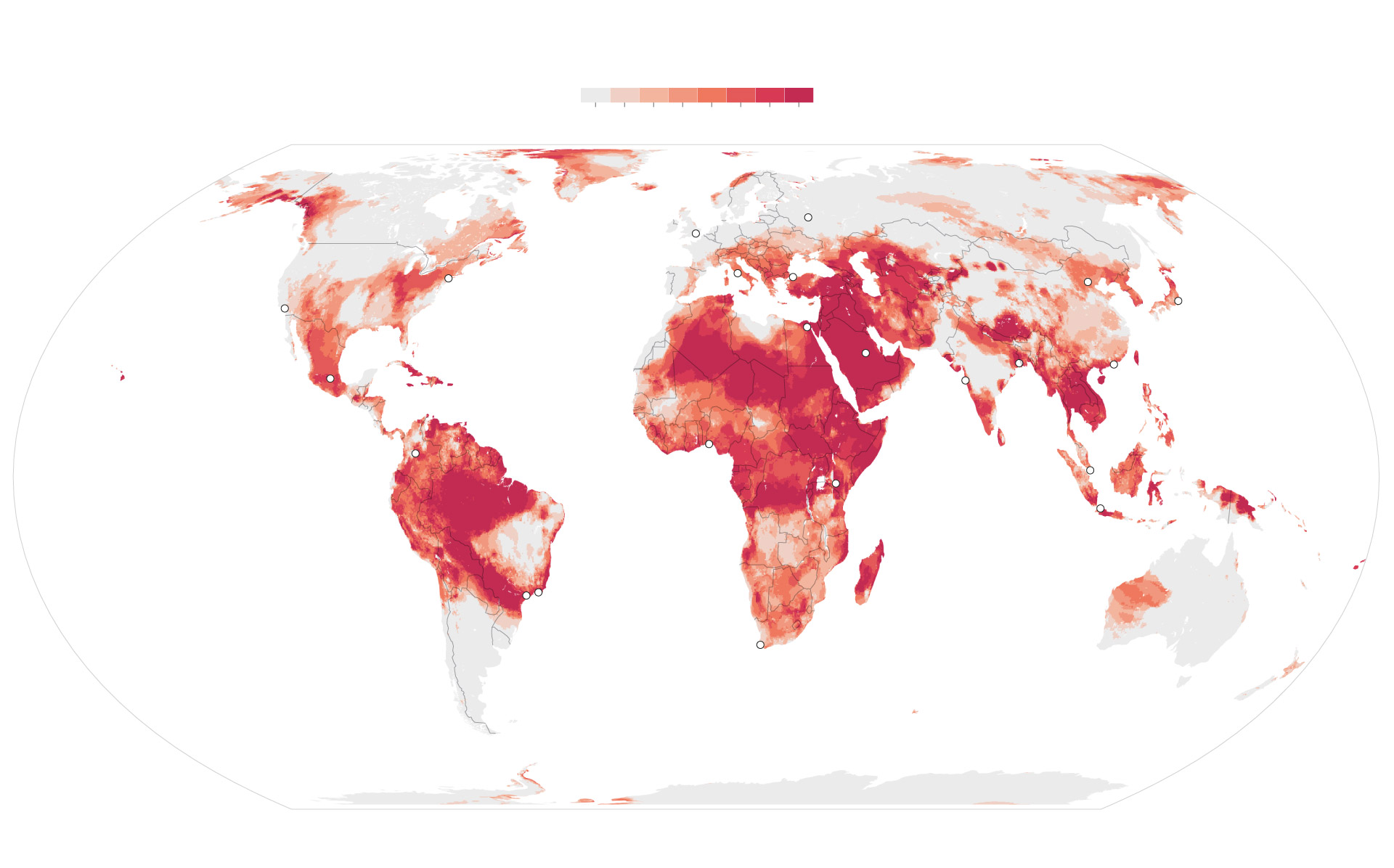
Number of days with temperatures made twice as likely to occur by climate change, June 15 to 21
JOHN MUYSKENS/THE WASHINGTON POST
Though not all temperatures seen around the world this week were unprecedented, they were nonetheless evidence of how the climate has shifted in a way that makes hot weather more likely to arrive earlier and last longer.
For some 80 percent of the world’s population — 6.5 billion people — the heat of the past week was twice as likely to occur because humans started burning fossil fuels and releasing greenhouse gases into the atmosphere, according to data provided to The Washington Post by the nonprofit Climate Central.
Nearly half that number experienced what Climate Central considers “exceptional heat” — conditions that would have been rare or even impossible in a world without climate change.
“What is really standing out is how many [heat waves] are happening at the same time,” said Andrew Pershing, the nonprofit’s director of climate science.
All week long, “exceptional” conditions could be found across much of Africa, the Middle East, southern Europe and…
Read More: Why intense heat waves are more likely because of climate change