


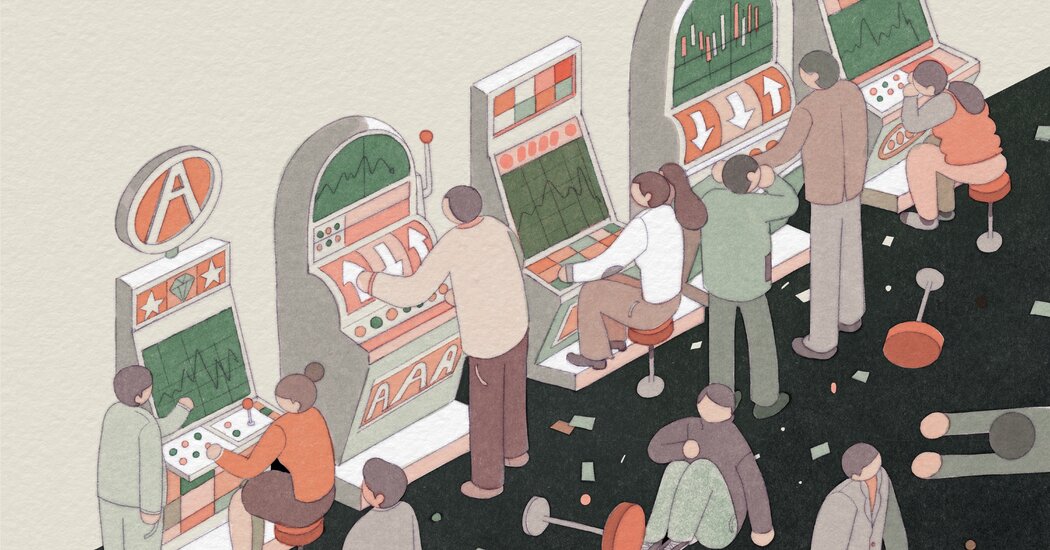
They call China’s stock market a “casino,” yet they are rushing in. They are betting money that the government really does want to finally crawl out of the hole it has dug. They are speculating, looking for short-term gains, with a great degree of uneasiness.
A flurry of policies by Beijing in recent weeks meant to stimulate the domestic economy has spurred China’s middle class to invest more in stocks, prompting the country’s biggest rally since 2008.
In recent interviews, investors said that doing something, even putting their savings into a market full of risks, gives them a sense of control when their country seems to be going astray. They worry that the government is doing more to prime the market than to help the economy, but for now they are clinging to a familiar, bubbly feeling in an era of deflation.
“We are all ‘garlic chives’ to be harvested by our ruler,” said Wang, a Beijing resident who said he invested more than $150,000. He invoked an online meme that says Chinese people are vegetables waiting to be plucked from the ground. “But if I take the initiative to participate in the market, at least I have some control over my destiny,” he said.
Mr. Wang was one of 10 Chinese investors I interviewed last week, some by video and others by email and text message exchanges. All of them are professionals or business owners. They have money to invest but are not super rich.
They all spoke on condition that I use only their surnames for fear of retribution. The government has censored articles and comments critical of its recent measures, which some said is contributing more to the market rally than it will to economic revival.
China reinstituted stock trading in the early 1990s — part of the country’s economic reform experiment. Potential investors lined up for hours and sometimes days to get into the game.
Now there are more than 200 million trading accounts in China’s stock market, and virtually all are for individual investors. But less than a quarter of those accounts are actively trading. China’s stock exchanges have not turned out to be wealth-generating venues for the Chinese public, who have largely avoided the market because it was so volatile.
Because the stock market was heavily controlled, most of China’s most competitive companies were largely unable or unwilling to be listed in their home country. There was little correlation between the market’s performance and China’s economy. The SSE composite index of companies that trade in Shanghai peaked in 2007, far before China’s economic expansion reached its pinnacle. And it lacked China’s highly successful start-ups like Alibaba, which went public in New York in 2014, and Tencent, which listed its initial public offering in Hong Kong in 2004.
Instead, people invested in real estate, which makes up about 70 percent of China’s household assets. While their wealth ballooned with rising housing prices, the government, which owns all land in the country, reaped most of the financial benefit. Now that the housing market has crashed, the government is luring people into the stock market.
The investors I interviewed told me they know the risks they are taking in the market, but they feel they have no choice in a country where the government controls the land, the banks and which companies can list on the stock exchanges.
“It’s even worse than a casino because a casino has rules, while our ‘casino’ has none,” Mr. Wang said. “Furthermore, the ‘owner’ of this casino can step in and play, and they can see our cards.”
He said he knew the recent rally might be a “trap,” but he felt he had no choice. “This way, I can find a spot closer to the exit, so when it’s time to escape, I can run out faster than others,” Mr. Wang said.
Another investor named Wang, from Shanghai, said he put money into Chinese stocks on Sept. 30. He summed up the prevailing sentiment among the people I talked to: People aren’t investing now because they trust, or have been fooled by, the government. “It’s just one bet where they’re willing to accept the outcome, win or lose,” he wrote in an email.
A software engineer in Shanghai named An said he lost his job and stock options at an online education start-up after the government cracked down on the industry in 2021. Then an apartment he bought wasn’t getting built. When he and other fellow home buyers protested, he was detained by police.
When the stock rally started in September, Mr. An said, his wife told him, “Let’s take a gamble.” They kept aside some cash for credit card debts and an emergency fund, and they invested the rest of their money, nearly 90 percent of their cash, into the market. That was more than $300,000. They are worried about inflation soaring…
Read More: Why Chinese Are Rushing Into a ‘Casino’ Stock Market