


The Biden administration is pausing a decision on whether to approve what would be the largest natural gas export terminal in the United States, a delay that could stretch past the November election and spell trouble for that project and 16 other proposed terminals, according to three people with knowledge of the matter.
The White House is directing the Energy Department to expand its evaluation of the project to consider its impact on climate change, as well as the economy and national security, said these people, who spoke on condition of anonymity because they were not authorized to publicly discuss internal deliberations. The Energy Department has never rejected a proposed natural gas project because of its expected environmental impact.
The move comes as Mr. Biden gears up for what is likely to be a contentious re-election campaign. He is courting climate voters, particularly the young activists who helped him win election in 2020 and who have been angered by his administration’s approval last year of the Willow project, an enormous oil drilling operation in Alaska.
It also comes as the United States leads the world in both liquefied natural gas exports and oil and gas production. The country has seven export terminals with five more already under construction.
The project in question, Calcasieu Pass 2, is among 17 additional terminals that have been proposed by the fossil fuel industry.
Still, Republicans and former President Donald J. Trump, who is expected to be his party’s choice to challenge Mr. Biden in November, are sure to try to use any delay in permitting against him, charging that Mr. Biden is hampering American energy.
“This move would amount to a functional ban on new LNG export permits,” Senator Mitch McConnell of Kentucky, the Republican leader, said on the Senate floor Wednesday. “The administration’s war on affordable domestic energy has been bad news for American workers and consumers alike.”
Mr. Trump, who has inaccurately called global warming a “hoax,” has promised to expand fossil fuel production and shred Mr. Biden’s climate agenda. “We’re going to drill, baby drill, right away,” he told voters after he won the Iowa caucuses earlier this month.
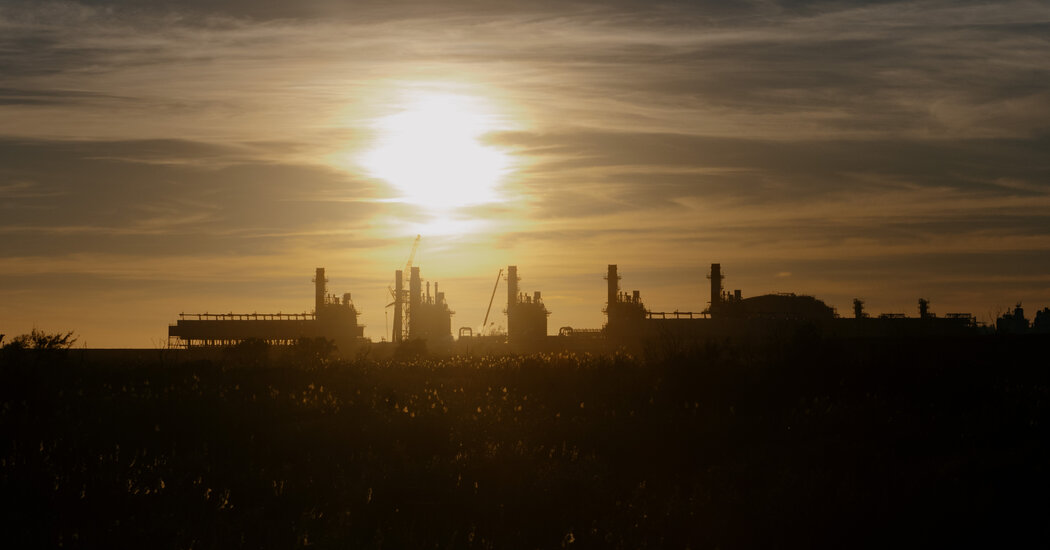
Calcasieu Pass 2, or CP2, would dwarf the country’s existing export terminals. The $10 billion project would be situated along a shipping channel that connects the Gulf of Mexico to Lake Charles, La. It would export up to 20 million tons of natural gas per year, increasing the current amount of exported American gas by about 20 percent.
The project first requires approval from the Federal Energy Regulatory Commission before it shifts to the Energy Department for consideration.
The Energy Department is required to weigh whether the export terminal is in “the public interest,” a subjective determination. But now, the White House has requested an additional analysis of the climate impacts of CP2.
Natural gas, which is primarily composed of methane, is cleaner than coal when it is burned. But methane is a much more potent greenhouse gas in the short term, compared with carbon dioxide, and it can leak anywhere along the supply chain, from the production wellhead to processing plants to the stovetop. The process of liquefying gas to make it suitable for transport is incredibly energy intensive as well, creating yet more emissions.
Whatever new criteria is used to evaluate CP2 would be expected to be applied to the other 16 proposed natural gas terminals that are awaiting approval.
Scientists have overwhelmingly said that nations must deeply and quickly cut the emissions from burning gas, oil and coal if humanity is to avoid climate catastrophe. Last month at the United Nations climate summit in Dubai, the United States joined 196 other countries in promising to transition away from fossil fuels.
More than 150 scientists signed a Dec. 19 letter to Mr. Biden, urging him to reject CP2 and the additional proposed facilities. “The magnitude of the proposed build out of LNG over the next several years is staggering,” they wrote. Approving new terminals would “put us on a continued path toward escalating climate chaos,” the letter said.
Given the scientific imperative, experts say that it is reasonable to consider climate impacts before building new gas export terminals.
“So far there is really no requirement to consider the cumulative climate, economic or market impact of all those facilities,” said Ben Cahill, a senior fellow in the energy security and climate change program at the Center for Strategic and International Studies, a nonpartisan research organization. “And it’s a very valid question.”
Shaylyn Hynes a spokeswoman for Venture Global LNG, the Virginia-based company that wants to build CP2, wrote in an email…
Read More: White House Said to Delay Decision on CP2, a Liquid Natural Gas Export Terminal