


Frank McCourt is the executive chairman of McCourt Global, a private family investment firm. He is also the founder and executive chairman of Project Liberty, a broad-based effort to build a better web for a better world. The project includes the development of an open internet protocol (the Decentralized Social Networking Protocol), which shifts data rights from platforms to people.
Michael Casey is Chief Content Officer at the CoinDesk media company, host of the Money Reimagined podcast, and the Chairman of the Consensus conference. He has worked as a journalist, including eighteen years with Dow Jones and The Wall Street Journal, and was a founding staffer at MIT’s Digital Currency Initiative.
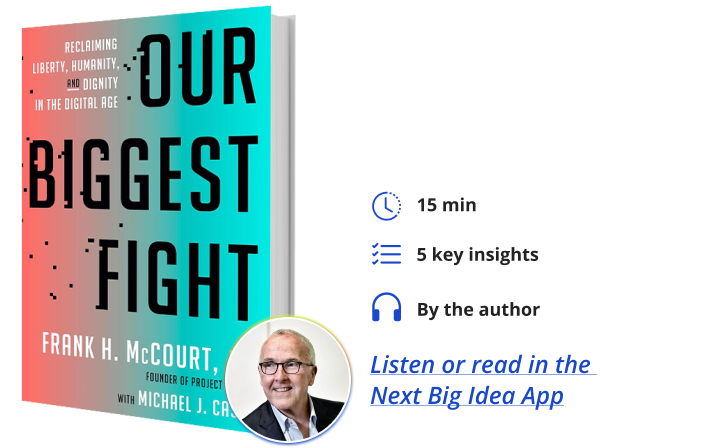
Below, Frank shares five key insights from his new book with Michael, Our Biggest Fight: Reclaiming Liberty, Humanity, and Dignity in the Digital Age. Listen to the audio version—read by Frank himself—in the Next Big Idea App.

1. The internet is broken.
Despite the connectivity and conveniences today’s internet provides, its current user experience is broken. The tech that underpins our daily lives is doing real damage. It’s fueling a youth mental health crisis, incentivizing the spread of misinformation and inflammatory content, breaking down civil discourse, and undermining our democratic institutions. These destructive trends all connect back to a corrupted and disabled information system.
From my perspective as a fifth-generation builder, the problem starts with the web’s basic architecture. For more than 130 years, my family has been developing infrastructure in America, starting with roads in the late 19th century and, eventually, the fiberoptic systems that enabled the internet back in the 1990s. We have an infrastructure and engineering problem; a design deficiency. The internet’s flawed design is the root cause of incredible harm.
The problems we’re seeing today are not an accident. It’s what happens when technology is co-opted and corrupted in ways that prioritize a few platforms, rather than the people who use it.
2. It doesn’t have to be this way.
We can change how the internet works. We can do this by shifting its power from platforms to people, returning control of data to individuals, giving us a voice in how platforms and applications are built, and enabling everyone to benefit economically from the data and content we’re creating.
This isn’t a pipe dream; it’s a natural next step. The first generation of the internet was enabled by a protocol called TCP/IP. The second generation, or the World Wide Web, was enabled by HTTP, which we use every day. Why not create a new protocol with a set of new operating rules?
“This protocol was designed to return ownership and control of data to individuals.”
With Project Liberty, we’ve developed and released an open, decentralized social networking protocol, called DSNP. This protocol was designed to return ownership and control of data to individuals. At the same time, this protocol gives developers the opportunity to build amazing new apps utilizing that data, but with our permission and on our terms. DSNP is available to anyone and stewarded by the nonprofit Project Liberty Foundation. It is providing the foundation for a new, healthier digital ecosystem. Apps on this new protocol will be interoperable. Our data and our social graphs will be portable. The platforms of the future would have to accept our terms and conditions for using our data, not the other way around.
If we can treat the internet’s flaws as an engineering problem and fix them, then we can begin to solve some of the societal problems the internet is creating and making worse. Most importantly, upgrading the internet will help leverage technology to benefit humanity.
3. Data is personal.
When you hear the word “data,” think “personhood.” We’re now living in a digital age, when everything we do is impacted by technology. We all search the internet. We all shop online. We all have smart devices in our pockets, cars, and homes. All of the tools and devices we use scrape our information and hand it over to a few giant platforms that decide what to with it. The things they’re doing aren’t optimized for society or humanity; they’re optimized to keep us online, to show us more ads, and to generate more revenue. Too often, we think of data-scraping as just a part of daily life. Too many people accept that “we’re the product,” even though we can break free from this dynamic and access great tech that doesn’t exploit, outrage, and addict us for profit.
We need to merge in our minds the notion of the biological us…
Read More: What it Will Take to Un-Break the Internet