


On a recent morning in eastern Ukraine, Karina Yatsina, a mine worker, was busy operating a conveyor belt in a dim, 1,200-foot-deep tunnel. Lights flickered at the end of the shaft, illuminating miners carving out the coal seams.
A year and a half ago, Yatsina, 21, was working as a nanny. Then friends told her that a mine in the eastern town of Pavlohrad was hiring women to replace men drafted into the military. The pay was good and the pension generous. It wasn’t long before Yatsina was walking through the mine’s maze of tunnels, a headlamp strapped to her red helmet.
“I would have never thought that I would be working in a mine,” Yatsina said, taking a short break in the sweltering heat of the tunnel. “I would have never imagined that.”
Yatsina is one of 130 women who have started working underground at the mine since Russia’s full-scale invasion of Ukraine began in February 2022. They now operate conveyors that carry coal to the surface, work as safety inspectors or drive the trains that connect the different parts of the mine.
“Their help is enormous because many men went to fight and are no longer available,” said Serhiy Faraonov, the deputy head of the mine, which is run by DTEK, Ukraine’s largest private energy company. About 1,000 male workers at the mine have been drafted, he said, or about a fifth of the total workforce. To help make up for the shortage, the mine has hired some 330 women.
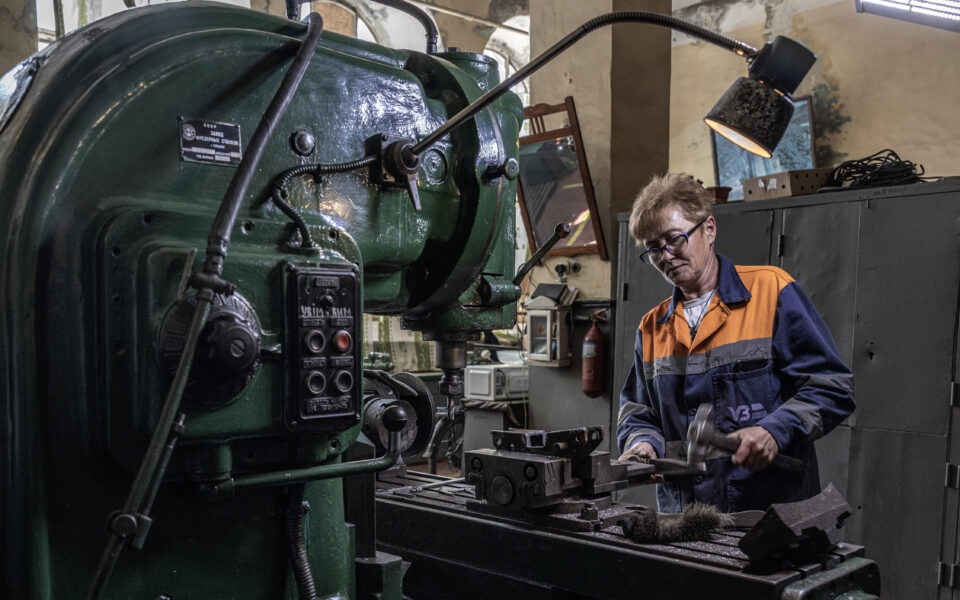
They are part of a wider trend in Ukraine, where women are increasingly stepping into jobs long dominated by men as the widespread mobilization of soldiers depletes the male-dominated workforce. They have become truck or bus drivers, welders in steel factories and warehouse workers. Thousands have also voluntarily joined the army.
In doing so, these women are reshaping Ukraine’s traditionally male-dominated workforce, which experts say has long been marked by biases inherited from the Soviet Union. “There was this perception of women as second-class and less reliable workers,” said Hlib Vyshlinsky, the executive director of the Kyiv, Ukraine-based Center for Economic Strategy.
Vyshlinsky said that Ukrainian women had long been excluded from certain jobs, not only over the physical demands but also because such roles were considered too complicated for them. Women, he said, could drive trolley buses, but not trains. “It was full of stereotypes.”
The current influx of women into the Ukrainian job market has echoes of the munitionettes, the British women who worked in arms factories during World War I, and the women — memorialized in the iconic posters of Rosie the Riveter — who went to work in the United States during World War II.
But even with the influx of women into the workforce, they will not be enough to replace all the male workers who have left, economists say. Three-quarters of Ukrainian employers have experienced labor shortages, a recent survey showed.
Before the war, 47% of Ukrainian women worked, according to the World Bank. Since then, some 1.5 million female workers, about 13% of the total, have left Ukraine, Vyshlinsky said.
“The share of women currently working in Ukraine is higher than before the war,” Vyshlinsky said. But too many have left Ukraine to allow the country to overcome its workforce shortages, he said.
The phenomenon of women joining the workforce has been particularly evident in the mining industry.
After Russia invaded in 2022, the Ukrainian government suspended a law that had barred women from working underground and in “harmful or dangerous” conditions. Now, they are a regular presence in the cramped lift shafts that take workers to the depths of the mines.
“I was surprised. It’s unusual to see a woman with a shovel doing a man’s work,” said Dmytro Tobalov, a 28-year-old miner, not long after a woman walked past him and other burly miners who were resting on benches in a tunnel, waiting to board the elevator back out of the mine.
Tobalov, who works at a mine in Pokrovsk, in the eastern Donetsk region, said 12 men had left his group of miners for the army, replaced by 10 men and two women. “They’re doing great,” he said of the women.
Several women said they had joined the Pokrovsk mine, owned by Metinvest, Ukraine’s largest steel-maker, because it offered stable jobs in a war-ravaged economy. Valentyna Korotaeva, 30, a former shop assistant in Pokrovsk, said she lost her job after a Russian missile landed near the shop, causing the owners to pack up and leave. She now works as a crane operator at the mine, moving large metal machines under repair in a warehouse.
How long Korotaeva can keep her job will depend on the situation on the front line, just 8 miles from the mine. Russian forces have been creeping closer to…
Read More: War is draining Ukraine’s male-dominated workforce. Enter the women.