


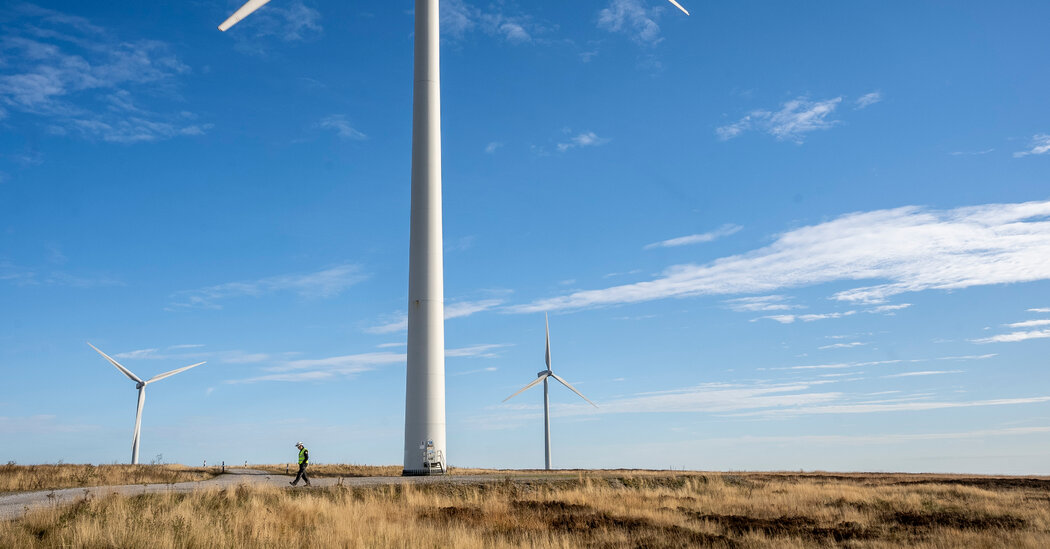
Were Heathcliff to roam the blustery moors around Wuthering Heights today, he might be interrupted by a ping on his cellphone saying something like this: The wind is raging, so power is cheap. It’s a good time to plug in the car.
OK. So the 18th-century literary occupants of these windswept hills received no such pings.
But Martin and Laura Bradley do. They live in Halifax, an old mill town below the wuthering, or windy, heights of West Yorkshire. And when a squall kicks up, producing a surplus of electricity from wind turbines on the moor, their phones light up with a notification, like one that informed them of a 50 percent discount one Saturday in October.
The Bradleys plugged in their electric Kia, started a load of laundry and set to work on their most delectable energy-guzzling project: the Christmas fruitcake, which is made weeks in advance of the holidays. “As this takes four hours to cook in my electric oven, this is the perfect timing!” Laura Bradley said.
The phone alerts to the Bradleys and thousands of other people are part of Britain’s ambitious plan to shift the nation’s electricity system away from burning fossil fuels altogether by decade’s end. That would be five years faster than the United States, and a full decade ahead of the European Union, effectively making it the most ambitious target of any major industrialized economy.
That means building many more solar and wind projects, as well as loads of batteries and transmission lines. It also requires persuading millions of Britons of the benefits — most importantly to their pocketbooks.
That’s where the Wuthering Heights pings come in.
Octopus Energy, the country’s biggest electricity supplier, runs nine wind turbines on those hills. When it’s gusty, and power is abundant, it offers discounts. The Bradleys say they save upward of 400 pounds ($517) a year. Octopus says it not only attracts customers but also persuades communities that they benefit from new energy infrastructure.
“We’ve got these famously bleak, windy hills,” said Greg Jackson, the company’s chief executive. “We wanted to demonstrate to people that wind electricity is cheaper, but only when you use it when it’s windy.”
It’s one of several creative experiments as Britain tries to persuade a wary public that ditching fossil fuels can improve their lives.
Ripple Energy, a London startup, invites people to buy a piece of a wind turbine in exchange for discount energy bills. In the town of Grimsby, a local cooperative invests in small solar projects that reduce bills for charities nearby. In North London, a developer has teamed up with Octopus to sell homes that run entirely on electricity — and whose occupants get free electricity for at least five years.
Britain’s 2030 ambition is a test of how quickly a rich country can build a new energy system. It is all the more notable for happening in a country that birthed the Industrial Revolution, ultimately producing the climate crisis that afflicts the world today.
Hitting the target faces many challenges.
There’s pressure on the government to enable developers to quickly build things like transmission lines. There’s pressure from communities to not spoil the countryside. And there’s pressure to overhaul regulations so that communities near the new infrastructure — Scotland for instance, which produces most of the country’s offshore wind — can get lower electric bills and in turn attract new energy-intensive businesses.
Natural gas still accounts for a third of the electricity mix. Replacing that with renewables in five years is no small feat. One recent analysis concluded that solar and wind projects currently planned would make up less than half of the electricity mix by 2030 without an enormous infusion of capital.
An oil man turns to batteries
Signs of the transition are in plain view. Wind turbines roar like dragons off the Scottish coast. Solar panels line the rooftops of football stadiums. And on an industrial patch of West Yorkshire, where for decades, three enormous power plants burned enormous piles of coal, a former oil worker, Ricky Harker, has been installing giant batteries.
There are 136 batteries in all, each the size of a tractor-trailer and owned by SSE, an energy giant that produces a lot of wind power in the North Sea.
The batteries are designed to harness wind and solar power and store it until its needed in the grid. “It’s part of the jigsaw,” said Mr. Harker, the project’s manager. “Something we can’t do without.”
Mr. Harker embodies the transition. His grandfather was a coal miner. His father worked in a coal-burning steel plant. Mr. Harker, too, apprenticed there and then worked on an oil rig, before an explosion killed five co-workers and literally drove him…
Read More: Utility in Britain Offers Free Electricity to Grow Clean Energy