


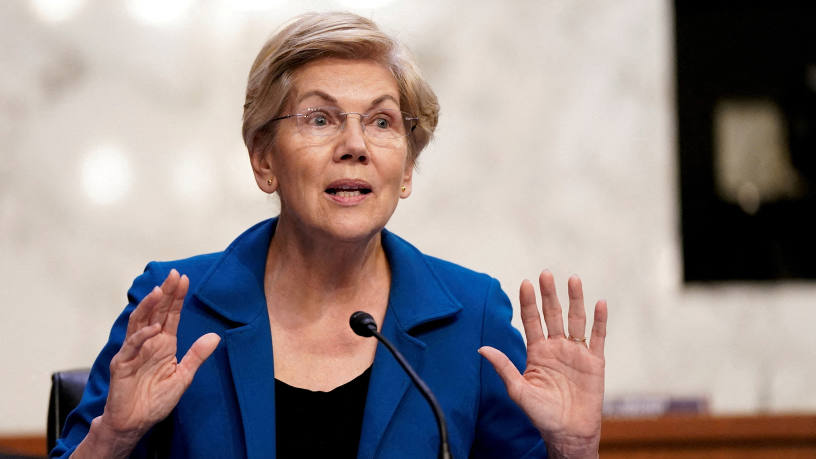
US Democratic senator Elizabeth Warren has called on Acting Comptroller of the Currency, Michael Hsu, to impose growth restrictions on Citigroup due to the bank’s ongoing regulatory issues.
In a letter to Hsu on Wednesday, first reported on by Reuters, Warren said that Citi’s persistent problems with fixing its data, risk control and other management issues indicate that the bank is “too big to manage” and should be curtailed.
“It is clearly time to protect the American financial system by imposing growth restrictions on Citi,” Warren wrote.
In 2020, the OCC and Federal Reserve fined Citi $400mn and mandated a plan to address risk management and operational failings. Despite these efforts, Citi was fined again in July for insufficient progress. Warren’s letter, although not enforceable, places pressure on Hsu to take action and brings further attention to Citi’s long-standing issues.
Warren cited Citi’s regulatory breaches, including its $900mn mispayment in 2020 to Revlon’s creditors and repeated violations of a Fed rule on intercompany transactions, as grounds for Hsu to implement growth restrictions.
Both Citi and the OCC declined to comment on the matter.
—
Global bank messaging network Swift plans to trial live transactions of tokenised assets and digital currencies on its network starting next year, it announced in a release on Thursday. The pilot will assess Swift’s ability to facilitate the flow of various forms of value, including digital currencies, using its established infrastructure.
Banks and asset managers have long been experimenting with tokenising assets, such as bonds, to streamline trading, reduce costs and eliminate intermediaries. However, adoption has so far been limited.
Around 90 per cent of the world’s central banks are testing central bank digital currencies, digital versions of fiat money, to enable the trading of tokenised assets. According to Swift, the tokenised asset market is projected to reach $16tn by 2030.
The rise of unconnected platforms has created a fragmented landscape, hindering global adoption. Swift’s trials aim to link these disparate networks, allowing financial institutions to transact seamlessly in both digital and traditional currencies.
Earlier this month, Swift joined Project Agorá, a Bank for International Settlements initiative exploring the integration of tokenised commercial bank deposits and wholesale CBDCs on a unified platform.
—
ANZ announced on Friday that it will pay a total of A$99mn ($67.76mn) to settle two class actions filed against the Australian lender in 2020.
The first case, relating to car loans issued between 2011 and 2016, involved the payment of “flex commissions” to ANZ-accredited car dealers. These commissions, banned in 2018 by Australia’s securities regulator, allowed dealers to set higher interest rates and longer loan terms to earn greater commissions. ANZ said it will pay A$85mn to settle this action.
The second class action involved ANZ’s superannuation products under its former unit, OnePath. It alleged that the trustee of the pension funds charged excessive fees to pay unnecessary commissions to financial advisers. ANZ will settle this case with a payment of A$14mn.
“The settlements are without admission of liability and each remain subject to court approval,” ANZ said in a statement.
—
The chief executive of Italy’s Mediobanca, Alberto Nagel, expressed his doubts on Thursday about the potential for cross-border banking mergers in Europe.
Speaking at Bloomberg’s annual Milan finance conference, Nagel noted that a possible UniCredit acquisition of Commerzbank would not qualify as a true cross-border deal, given UniCredit’s ownership of German bank HVB.
Intesa Sanpaolo chief executive Carlo Messina agreed, stating that UniCredit’s existing presence in Germany put it in a strong position for a tie-up with Commerzbank. “In Germany, UniCredit and Deutsche Bank are the only two banks that can create value from an integration with Commerzbank,” Messina said.
Nagel pointed to other recent deals, such as BBVA’s bid for Sabadell and BNP Paribas’ acquisition of AXA’s asset manager, as better examples of consolidation, noting that European financial regulations favour such deals over cross-border mergers due to the ring-fencing of liquidity and capital at a single-country level.
Messina added that Intesa would not pursue acquisitions in the next two years, focusing instead on internal growth and technology improvements.
Read More: US senator Warren urges regulator to cap Citi’s growth; Swift to pilot live