


It’s not easy to move the needle when it comes to sustainability, but India‘s Shahi Exports Ltd. is headed in the right direction.
The second sustainability report for the company, titled “Moving the Needle,” outlines the changes the firm has introduced in context of the crucial need for greener practices within the fashion industry.
Harish Ahuja, chairperson and managing director at Shahi, expressed pride in the “remarkable progress in integrating sustainability into the fabric of the business operations.”
“We have moved the needle on our planet targets, increasing our water recycling capacities and renewable energy capacity to 92.5MW, bringing us closer to our goal of 100 percent renewable electricity by 2026.” Shahi also joined Fashion for Good and the Organic Cotton Accelerator to drive innovative and scalable solutions, he noted, while continuing its research and development focus to bring in “groundbreaking innovations in materials, chemicals and even new business models,” including as an early investor in DXM, an on-demand manufacturing platform. “We were thrilled to see a successful pilot with Carhartt, shipping custom clothing directly to the end consumer from our factories,” he noted in the chairperson’s message.
Shahi has an extensive network of more than 50 factories, three mills, and three corporate offices—with the headquarters in New Delhi—and produces more than 143 million garments annually.
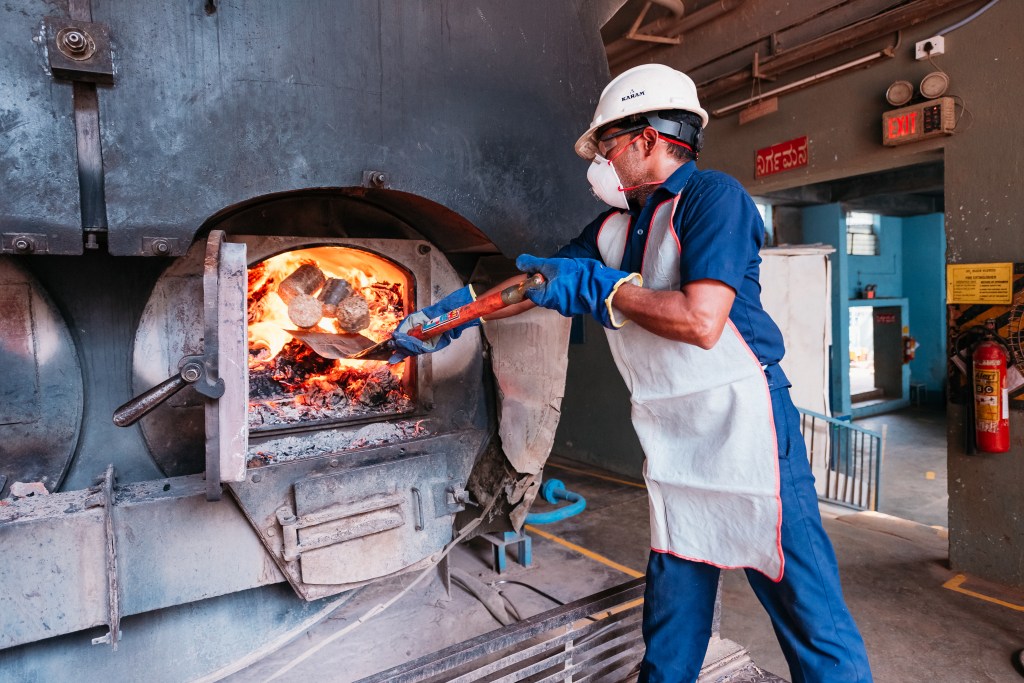
Another highlight, the report elucidated, has been the phasing out of coal from garment factories, and the continuing work toward eliminating coal from mills. “I think the progress we have made on our energy and electricity goals is quite unique. Close to 70 percent of our electricity is coming from renewable sources. We’re seeing a path to taking that to 100 percent. I think that’s really exciting,” Anant Shahi, head of ESG at Shahi, told Sourcing Journal. “So much of the world has moved away from coal—in India we are still very reliant on it—but because we supply to global brands and retailers they’ve been pushing us to find ways to remove coal from manufacturing.
“We don’t have all the answers yet,” he added. “We’ve done it for garmenting. Now, the big challenge is to do it for textile making—because it is so energy intensive. There are a lot of great ideas, and hopefully it’s one of those things where there will be gradual process. We’ll get to see some light at the end of the tunnel, and before you know it, we’ll all be off coal and powered by much cleaner power sources.”
This has also set the way toward reducing carbon emissions.
“The journey towards coal elimination has required retrofitting boilers to accommodate biomass. Notably, our traditional reliance on coal for on-site energy generation has been progressively replaced by biomass, resulting in 36 percent carbon-neutral energy, with a goal to achieve a 50 percent carbon-neutral energy status by 2026,” Ahuja said.
As one of the biggest players in the Indian industry, Shahi also plays role model. “As a vertically integrated supplier, we understand our pivotal role in influencing sustainability across the entire ecosystem,” he added. “As the industry inches closer to its 2025 and 2030 goals, there is a growing realization that we need to move faster. We need more investments, collaboration, and radical innovation to achieve our collective goals of sustainability.”
“Most of the action needs to be on the ground where the manufacturing is happening,” Anant Ahuja observed. “When brands set targets around materials, decarbonization and equity, most of that has to be executed and achieved in the supply chain. This strategy recognizes that approximately 70 percent of the fashion industry’s greenhouse gas (GHG) emissions come from the supply chain, covering material production, yarn preparation, fabric preparation, wet processes, and garment manufacturing.”
Some highlights of the report include:
– An investment of 1.2 million hours in upskilling its employees in behavioral and technical skills.
– Continued soft skills training for women through the Gap Inc. P.A.C.E. program, reaching more than 86,000 women since 2007 and completing 96 percent of the 2024 training target.
– Partnering with the International Organization for Migration (IOM) to support migrant workers and launching the YESS: Yarn Ethically and Sustainably Sourced program to mitigate the risk of forced labor in supply chain.
– 8.75 MW of wind energy installed, resulting in a total of 92.5 MW renewable capacity.
– 78% Verified Higg FEM score, against the…
Read More: Shahi Exports Touts Sustainability Progress – Sourcing Journal