


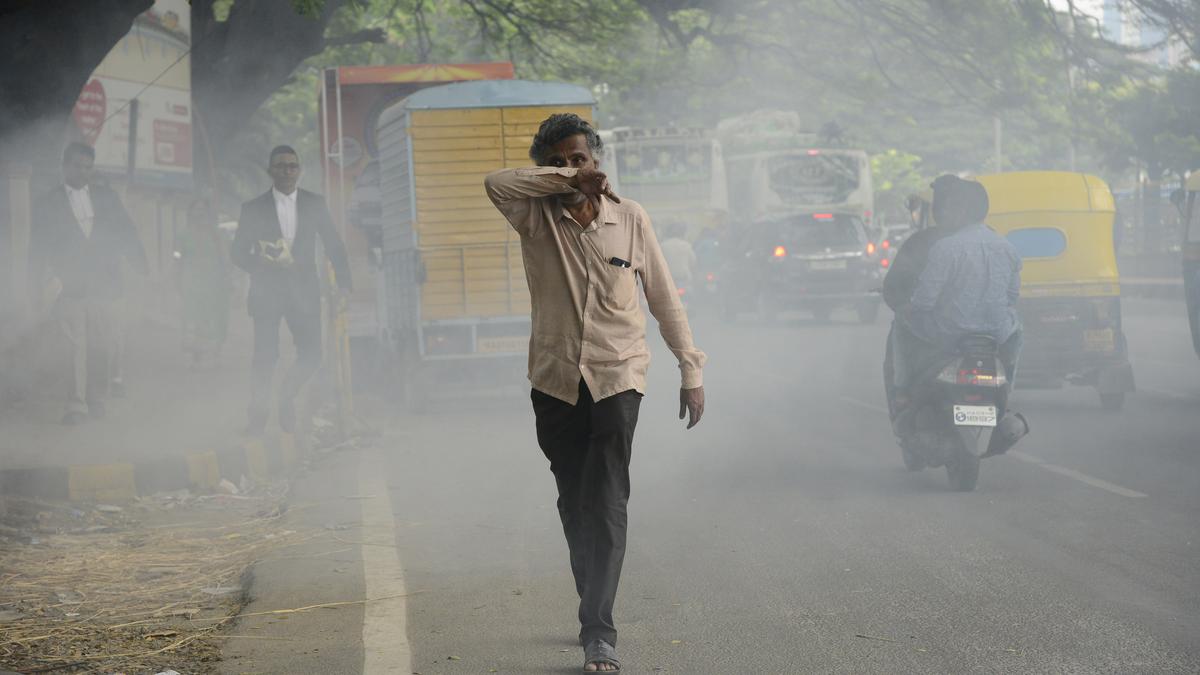
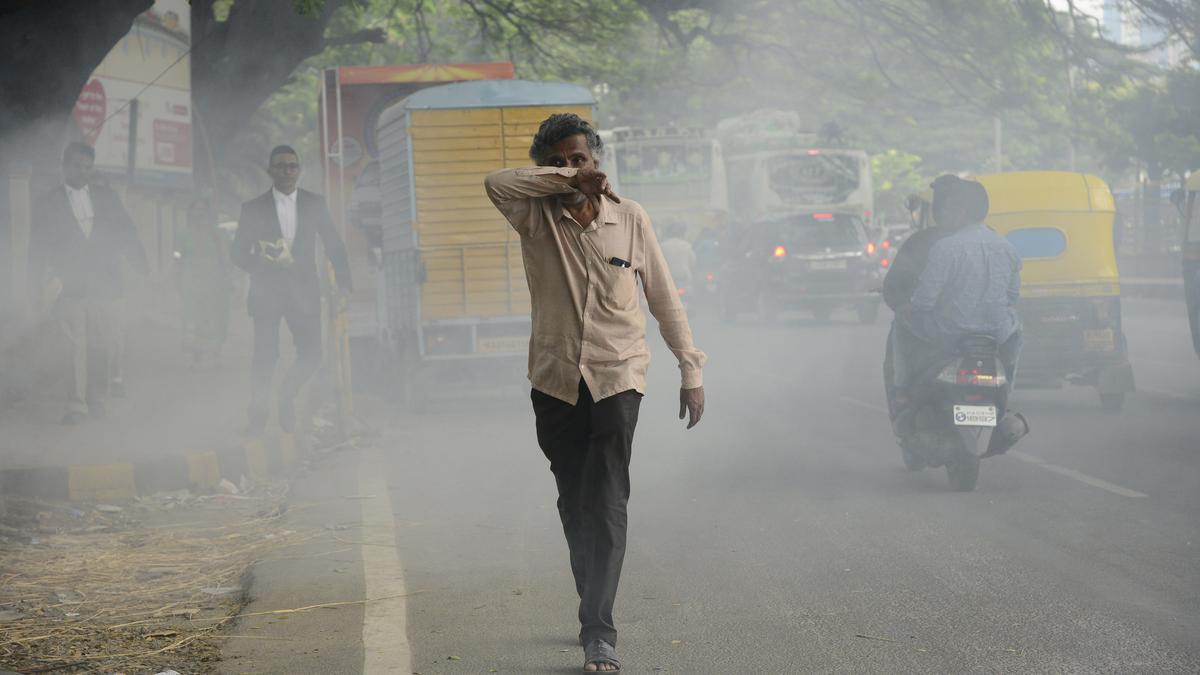
The study shows that in Hubballi-Dharwad, transportation sector was the primary contributor to PM2.5 emissions, while industries and transportation were the major contributors to SO2 and NOx in Davangere, Kalaburagi, and Hubballi-Dharwad cities.
| Photo Credit: File photo
The PM2.5 (Particulate matter of 2.5 micrometres or less in diameter) emissions in three cities in Karnataka – Davangere, Kalaburagi, and Hubballi-Dharwad, will increase by 31% to 38% in 2030, revealed a study conducted by the Centre for Study of Science, Technology, and Policy (CSTEP), a research-based think tank.
The study shows that in Hubballi-Dharwad, the transportation sector was the primary contributor to PM2.5 emissions, while industries and transportation were the major contributors to Sulphur Dioxide (SO2) and Oxides of Nitrogen (NOx) in all three cities.
While implementing targeted interventions can reduce PM2.5 emissions in all three cities, the study estimates that a capital investment of ₹582-₹968 crore is necessary to implement the control measures and achieve clean air.
The study also lists out several interventions that can be taken up like increasing the penetration of LPG cylinders in Davangere where increasing the penetration to 93% can result in a 37% reduction in PM2.5 emissions in domestic sector and 12% reduction in total PM2.5 emissions.
It further says: “There are around 950 puffed rice mills present in the region. The Karnataka State Pollution Control Board should encourage puffed rice industries to switch to cleaner fuels and install bag filters to capture and control particulate matter at source. Transitioning puffed rice industries to cleaner fuel sources could help achieve 40% reduction in emissions within the industrial sector”.
The study also identified that heavy commercial vehicles contribute to 70% of total emissions in Hubballi-Dharwad and 76% in Kalaburagi. The study suggested implementation of priority measures such as retrofitting diesel particulate filters in trucks older than 10 years, increasing public modal share through introduction of electric/CNG buses, promoting electric/CNG vehicles (two-wheelers and cars), and encouraging light commercial vehicle owners to shift to cleaner fuels to combat the emissions.
The findings are a part of ‘CSTEP’s Emission Inventory for 76 Cities’, a visualisation portal, that will be launched at the India Clean Air Summit 2024 which will be held between August 26 and August 30 in Bengaluru.
“The study covers 76 non-attainment Indian cities in total, and data suggests that only a few cities are on track to achieving the National Clean Air Programme targets. The research spanning 2.5 years suggests that only eight of the studied cities will be able to achieve a 40% emission reduction by 2030. Further, local emissions are expected to increase by 11%-45% in these cities till 2030, relative to 2019 levels, significantly increasing pollution levels,” a press release from CSTEP said.
Read More: PM2.5 emissions in three cities in Karnataka to increase by 31% to 38% by 2030: