


The gathering raised $2.2 billion for clean cooking in Africa, where four in five people still use polluting energy like charcoal – but some say LPG should not be promoted as a transition fuel
The challenge of providing around one billion Africans with cleaner and healthier ways of cooking got a major funding boost this week, as governments and companies put $2.2 billion on the table at a summit in Paris to help solve the long-neglected problem.
But the money pledged still falls short of the $4 billion a year needed for the rest of this decade to wean poor African households off traditional dirty fuels including charcoal, kerosene and firewood, while climate campaigners criticised efforts to switch them to fossil gas.
Countries such as Brazil, Indonesia and India have made progress in recent years, in line with a global goal to provide clean cooking for all by 2030. Yet four in five Africans still use highly polluting cooking methods – around half of the 2.3 billion people who lack clean options worldwide, according to the International Energy Agency (IEA).
IEA Executive Director Fatih Birol told the summit his organisation’s aim of making 2024 “a turning point” for clean cooking was being realised.
“It’s now or never,” he said, adding that the IEA will track the commitments made in Paris and share the results with the international community in a year’s time. “We will follow it as if it is our own money,” he emphasised.
In Nagorno-Karabakh, Azerbaijan’s net zero vision clashes with legacy of war
Separately, the African Development Bank (AfDB) confirmed an earlier pledge, first made at the COP28 climate summit last year, to mobilise around $2 billion for clean cooking over the next 10 years, earmarking 20 percent of its energy finance for that purpose.
Speaking in Paris, AfDB president, Akinwumi A. Adesina, said his own eyesight had been damaged by smoke from cooking fires during his childhood in Nigeria, while a friend and members of her family had died in an accident after she was sold petrol instead of kerosene as cooking fuel.
“Why do we let things like that happen?” Adesina asked, adding that enabling clean cooking is a matter of “human dignity, fairness and justice for women”. “It is about life itself,” he said.
Experts have long pointed to the health damage to women and children from carbon monoxide and black soot emitted by cooking over open fires or with basic stoves. Dirty cooking contributes to 3.7 million premature deaths annually, according to the IEA, with women and children most at risk from respiratory and cardiovascular ailments linked to indoor air pollution.
Ahead of the Summit on Clean Cooking in Africa this week in Paris, some climate and gender activists pointed to the small number of African women represented at the gathering – who they said accounted for less than a fifth of registered participants.
Janet Milongo, coordinator of renewable energy for Climate Action Network International, said the event was biased “towards the continuation of the colonial, patriarchal representation of the continent”.
Speeches were made largely by male leaders of governments and companies, with the notable exception of Tanzania’s president, Samia Suluhu Hassan, and Damilola Ogunbiyi, the UN Secretary-General’s Special Representative for Sustainable Energy for All.
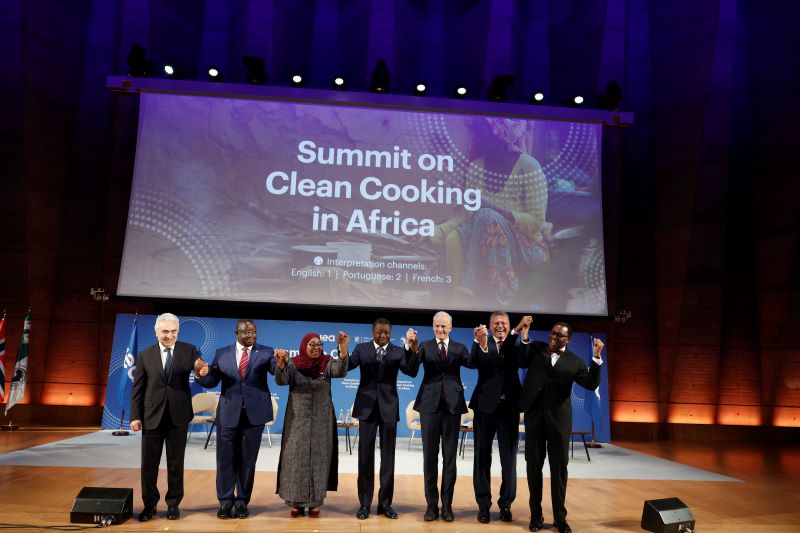
Fatih Birol, Executive Director of the International Energy Agency (left) with the presidents of Sierra Leone, Tanzania and Togo, the prime minister of Norway; H.E. Maroš Šefčovič, Executive Vice President of the European Green Deal and Akinwumi A. Adesina, President of the African Development Bank Group at the Clean Cooking Summit for Africa in Paris, May 14, 2024 (Photo: International Energy Agency)
Clean cooking ‘opportunity’ in NDCs
Ogunbiyi, who is Nigerian and has worked on clean energy policy for the government, said her country had made a big effort on solar electrification but had forgotten about clean cooking.
“We can’t make that mistake again,” she said, calling for clean cooking to be a key part of African governments’ investment plans for their energy transition.
UN climate chief Simon Stiell urged more governments to seize the opportunity to include measures to boost clean cooking in the next updates to their national climate action plans (NDCs) due by early next year.
As of December last year, only 60 NDCs included one or more measures that explicitly target clean cooking, such as Nepal’s goal to ensure that by 2030 half of households use electric stoves as their main mode of cooking and Rwanda promising to disseminate modern efficient cookstoves to 80% of its rural population and 50% of people in cities…
Read More: Paris summit funds clean cooking in Africa, avoiding gas concerns