


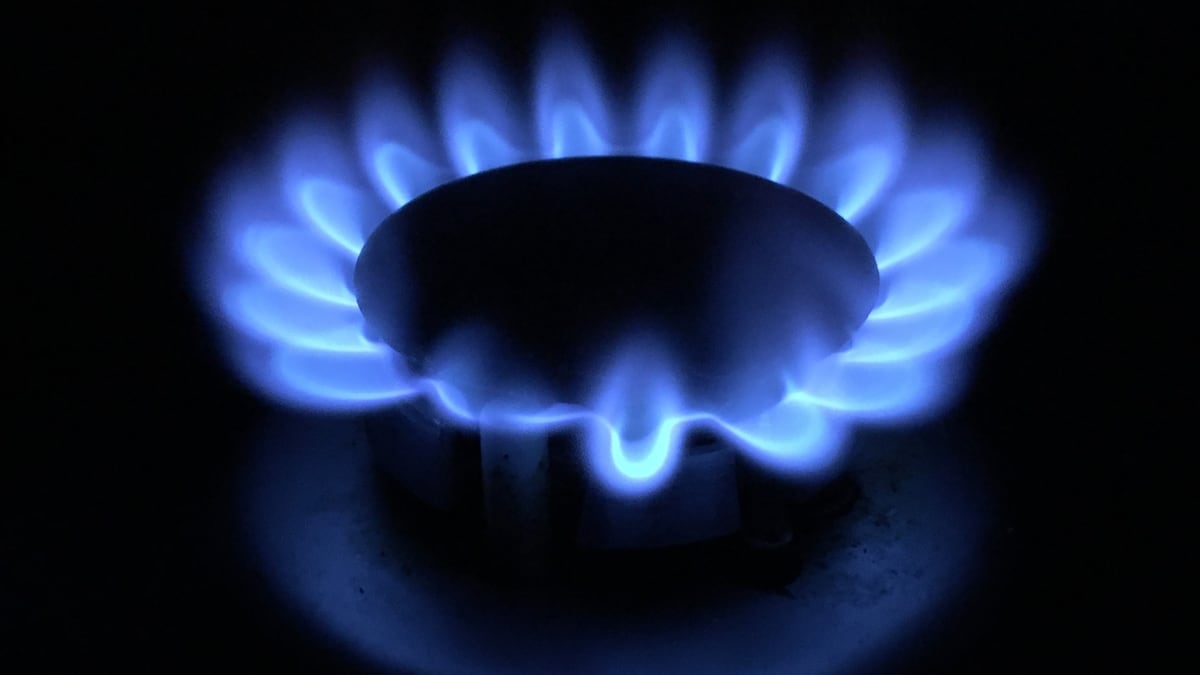

A blue flame burns on a natural gas stove.
Cassandra Profita / OPB
Oregon’s largest gas utility has been ordered to phase out natural gas subsidies by November 2027, a move that environmental advocates say will help lower customers’ bills and could begin reducing the number of new gas customers within the utility.
On Friday, the Oregon Public Utilities Commission ordered NW Natural to phase out its line extension allowance starting Nov. 1 and eliminate it entirely by Nov. 1, 2027. A line extension allowance is a subsidy that helps connect new customers to the utility and is paid for by existing customers through rates.
“We find significant risk that the purported benefits to current customers of paying the Line Extension Allowance will not materialize, and we weight risks to current customers more heavily than we do providing an advantage to new customers who are arriving to the gas system at a time of significant future policy, market, and cost uncertainty,” the OPUC commissioners wrote in the order.
The utility, which serves more than 2.5 million people in Oregon and Southwest Washington, argues its model and subsidies allow it to responsibly grow its system while also meeting decarbonization goals.
Friday’s order by the utility commission comes ahead of an upcoming ruling about gas rates, and features decisions about costs that are allowed to affect how much customers pay. The commission expects to announce NW Natural’s approved rates on Tuesday, as well as rate decisions for other regulated Oregon gas utilities.
According to the order, NW Natural stated eliminating the line extension allowance would be an “extreme measure and that no Oregon law limits the growth of the natural gas system” and that it’s too soon to “prejudge” the future of the gas system.
“We must continue to accept that Oregon’s direction toward requiring gas companies to reduce emissions is likely to continue,” the OPUC order read. “We will continue to evaluate Line Extension Allowances proposals with emissions reductions in mind unless and until that overall direction changes in a durable way.”
NW Natural spokesperson David Roy said the company is still reviewing the order but is disappointed with the decision to phase out the line extension allowance.
“We believe our proposal, which is a first-of-its-kind model in the country, supports the state’s goals for increased housing and reduced greenhouse gas emissions,” he said. “We will continue to pursue pathways that allow Oregonians, including low- and moderate-income customers, to have access to two energy systems—electric and gas—for their homes and businesses.
The OPUC order comes at a time when the utility is facing mounting pressure to move away from natural gas and begin implementing electrification measures. Natural gas or methane gas, is a powerful greenhouse gas that is 86 times more potent at trapping heat in the atmosphere than carbon dioxide over a 20-year period and a contributor to human-caused climate change.
Last year, the commission ruled the utility’s long-term plan to reduce greenhouse gas emissions was insufficient to meet Oregon’s climate goals. Environmental advocates say the decision to phase out line extension allowances is a big deal and could be an indicator of what is to come for the future of the gas industry in Oregon.
“What we’re really seeing out of this order is a decision by the commission is to both transition away from fossil fuels, in a sense, but also get rid of subsidies that are creating these perverse incentives to continue to grow our demands for fossil fuels and that’s a big deal because this is something that commissions in other states are doing,” Earthjustice senior attorney Jaimini Parekh said.
Earthjustice, along with other environmental and climate groups, were intervenors by representing the public’s interests in NW Natural’s general rate case. The groups said the company overspent line extension allowances by more than $16 million during a five-year period from 2018-2023.
In one example, Parekh said the environmental groups found the utility overcharged $60,000 for a new connection.
According to the OPUC order, NW Natural’s highest subsidy was $2,875.
“It is fundamentally unfair to be charging ratepayers for these costs,” she said.
OPUC ordered NW Natural to remove nearly $14 million from the proposed rate case due to the overcharging. Parekh said that could help lower the projected increase set for Nov. 1.
“The commission is acting on behalf of the public to take action to help the state transition away from fossil fuels and doing that by getting rid of harmful subsidies that make it difficult for people to move away from gas,” Parekh said.
The commission also approved a partial…
Read More: NW Natural ordered to phase out new gas connection subsidies by 2027