


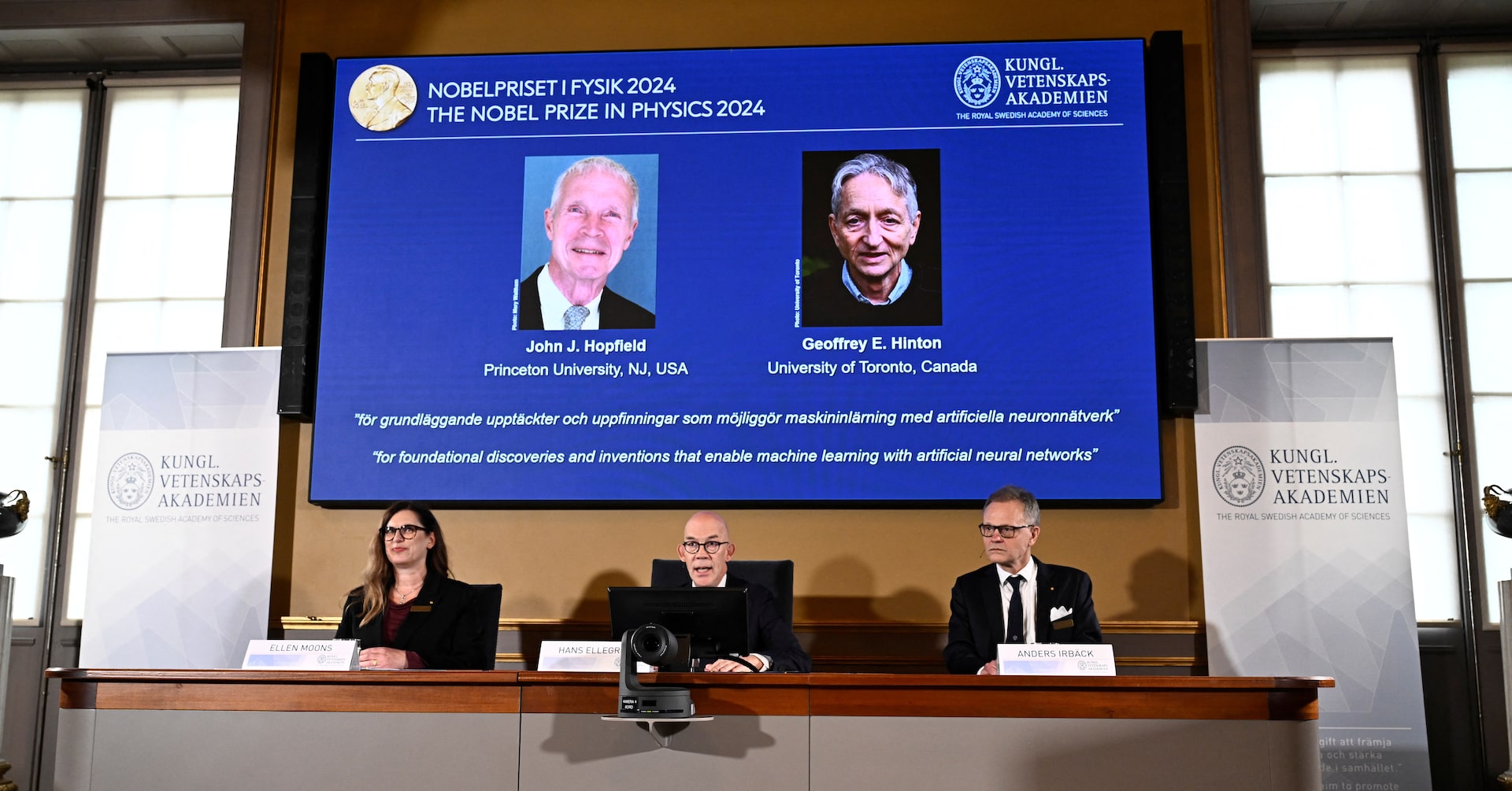
STOCKHOLM, Oct 8 (Reuters) – U.S. scientist John Hopfield and British-Canadian Geoffrey Hinton won the 2024 Nobel Prize in Physics on Tuesday for discoveries and inventions in machine learning that paved the way for the artificial intelligence boom.
Heralded for its revolutionary potential in areas ranging from cutting-edge scientific discovery to more efficient admin, the emerging technology on which the duo worked has also raised fears humankind may soon be outsmarted and outcompeted by its own creation.
Hinton has been widely credited as a godfather of AI and made headlines when he quit his job at Google (GOOGL.O) last year to be able to more easily speak about the dangers of the technology he had pioneered.
“We have no experience of what it’s like to have things smarter than us,” Hinton said over the phone to the Nobel press conference, speaking from a hotel in California.
“It’s going to be wonderful in many respects, in areas like healthcare,” Hinton said. “But we also have to worry about a number of possible bad consequences. Particularly the threat of these things getting out of control.”
Hopfield, 91, a professor emeritus at Princeton University, created an associative memory that can store and reconstruct images and other types of patterns in data.
“When you get systems that are rich enough in complexity and size, they can have properties which you can’t possibly intuit from the elementary particles you put in there,” he said in a press conference convened by Princeton. “You have to say that system contains some new physics.”
He echoed Hinton’s concerns, saying there was something unnerving about the unknown potential and limits of AI.
“One is accustomed to having technologies which are not singularly only good or only bad, but have capabilities in both directions,” he said.
The Royal Swedish Academy of Sciences said it awarded the prize to the two men because they used “tools from physics to develop methods that are the foundation of today’s powerful machine learning” that is “revolutionising science, engineering and daily life.”
The award comes with a prize sum of 11 million Swedish crowns ($1.1 million) which is shared by the two winners.
British-born Hinton, 76, now professor emeritus at the University of Toronto, invented a method that can autonomously find properties in data and carry out tasks such as identifying specific elements in pictures, the academy said.
Though he quit Google in 2023 after realising computers could become smarter than people far sooner than he and other experts had expected, Hinton said the company itself acted very responsibly.
Item 1 of 5 John J Hopfield and Geoffrey E Hinton are awarded this year’s Nobel Prize in Physics, which is announced at a press conference by Hans Ellegren (centre), Secretary General at the Swedish Academy of Sciences, Stockholm, Sweden October 8, 2024. TT News Agency/Christine Olsson via REUTERS
[1/5]John J Hopfield and Geoffrey E Hinton are awarded this year’s Nobel Prize in Physics, which is announced at a press conference by Hans Ellegren (centre), Secretary General at the Swedish Academy of Sciences, Stockholm, Sweden October 8, 2024. TT News Agency/Christine Olsson via REUTERS Purchase Licensing Rights
Hinton also said he regretted some of his research, but that he acted on the information he had at the time.
“In the same circumstances I would do the same again,” he told the Nobel press conference. “But I am worried that the overall consequence of this might be systems more intelligent than us that eventually take control.”
‘MIND FROM MACHINE’
Asked about the concerns surrounding machine learning and other forms of artificial intelligence, Ellen Moons, chair of the Nobel Committee for Physics, said: “While machine learning has enormous benefits, its rapid development has also raised concerns about our future.
“Collectively, humans carry the responsibility for using this new technology in a safe and ethical way, for the greatest benefit of humankind.”
Hopfield, whose parents were both physicists, said in a video posted online by the Franklin Institute when he won the 2019 Benjamin Franklin Medal in Physics that he had never considered being anything but a scientist or engineer.
“They were the ones that understood the world,” he said. “What fascinates me most is still this question of how mind comes from machine.”
Widely considered the most prestigious award for physicists across the world, the prize was created, along…
Read More: Nobel physics prize 2024 won by AI pioneers John Hopfield and Geoffrey Hinton