


By Michaela Haas for Reasons to be Cheerful.
Broadcast version by Mark Moran for Big Sky Connection reporting for the Solutions Journalism Network-Public News Service Collaboration
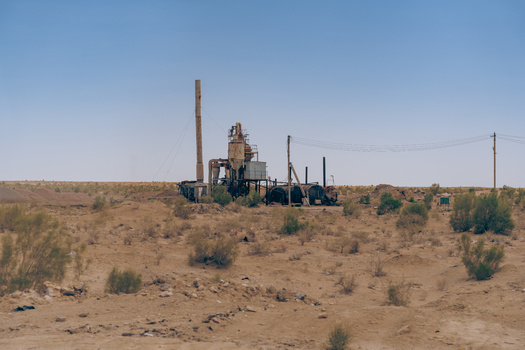
Curtis Shuck was inspecting wheat crops with farmers in rural Northern Montana in 2019 when he followed a rotten-egg stench and spotted corroded metal surrounding a borehole. The discovery he stumbled upon would change his life, and eventually the trajectory of carbon emissions in the US: He came across an abandoned oil well that spewed pollution, including methane, into the air and surrounding fields. Once he realized what he was looking at, he identified other wells across the surrounding landscape, left behind in the 1990s after the Gulf War tanked crude prices.
“I couldn’t believe what I saw,” Shuck says with his heavy Texan drawl. “I was just at the wrong place at the wrong time. Or I was at the right place, depending on how you want to look at it.”
The pollution left such a deep impression on the former oil and gas executive that he immediately wanted to take action. His plan: to plug as many oil wells as possible. Before the day was over, he had come up with a name for a nonprofit, Well Done, and registered the domain name TheWellDoneFoundation.org from his truck.
What started out as the epiphany of one hard-charging man has since led to the capping of 45 wells in 14 states. “We just capped our 45th well in Akron, Ohio,” Shuck says by phone from the departures hall at the airport in Portland, Oregon, on his mission of crisscrossing the country to find the most urgent wells. “Through that, we have saved over one million tons of CO2e. That’s what’s so exciting about our work. It’s literally gas on, gas off. The benefit is immediate.”
This is the story of one man making a sizable difference, but also of the toxic legacy the oil and gas boom has left all over the US. Curtis Shuck is mitigating global warming one well at a time.
An unbelievable 3.7 million abandoned oil and gas wells litter the country and belch more than 300 kilotons of methane or 8.2 million metric tons of CO2e every year, according to the Environmental Protection Agency. More than half of these wells (58 percent) are unplugged and at least 126,000 wells are “orphaned,” meaning regulators can no longer find a company or owner to hold accountable. Maybe the oil company went out of business or bankrupt – and landowners and communities are frequently left with the destruction after oil producers have moved on. Often records have gone missing, and nobody even knows where all the old wells are located. “That number just keeps increasing exponentially as oil companies go out of business,” Shuck adds.
About 10 percent of the abandoned wells emit large amounts of methane, a greenhouse gas significantly more potent than carbon dioxide in the short term, because of its heat-trapping potential. Studies have found that swift actions to cut methane emissions could slow Earth’s warming by 30 percent. The worst well Shuck plugged was emitting more than 10,000 grams of methane per hour. Some also leak other pollutants and brine into surrounding fields or waterways. “It is actually quite difficult to assess how much emission is really occurring,” says Adam Peltz, a senior lawyer at the Environmental Defense Fund. “You could go measure on a Tuesday afternoon and again on Thursday morning and get two completely different results.”
The oil graveyards have only recently begun to draw attention as major contributors to climate change that demand urgent action. Though Shuck had been working in the oil industry for decades, first as the president of Red River Oil Services in North Dakota, supplying drilling rigs, and then as a transportation and logistics expert for the Port of Vancouver, “I never knew that many wells were simply abandoned,” Shuck says. “That was the industry’s dirty little secret, and nobody wanted anything to do with it.”
He plugged the first well in 2020 “out of our piggy bank, with my and my wife’s savings.” To this day, he does not draw a salary from Well Done. While still working as a consultant for transportation logistics, he says, “plugging oil wells is my side hustle that takes 90 percent of my time.”
Among the dozens of requests he receives every month from landowners, regulatory agencies and communities, he prioritizes the “most urgent wells.” Factors include not only the amount of methane and other carcinogens an orphaned well emits, but also how close the well is to a community and how severe the impacts of its pollution. “I’ve worked on abandoned wells that leak oil into the waterways,” he gives as an urgent example. “That’s so alarming you want to get to work right away.”
Once Well Done “adopts” a well, the organization accepts…
Read More: Montana rancher works to cap abandoned oil and gas wells / Public News Service