


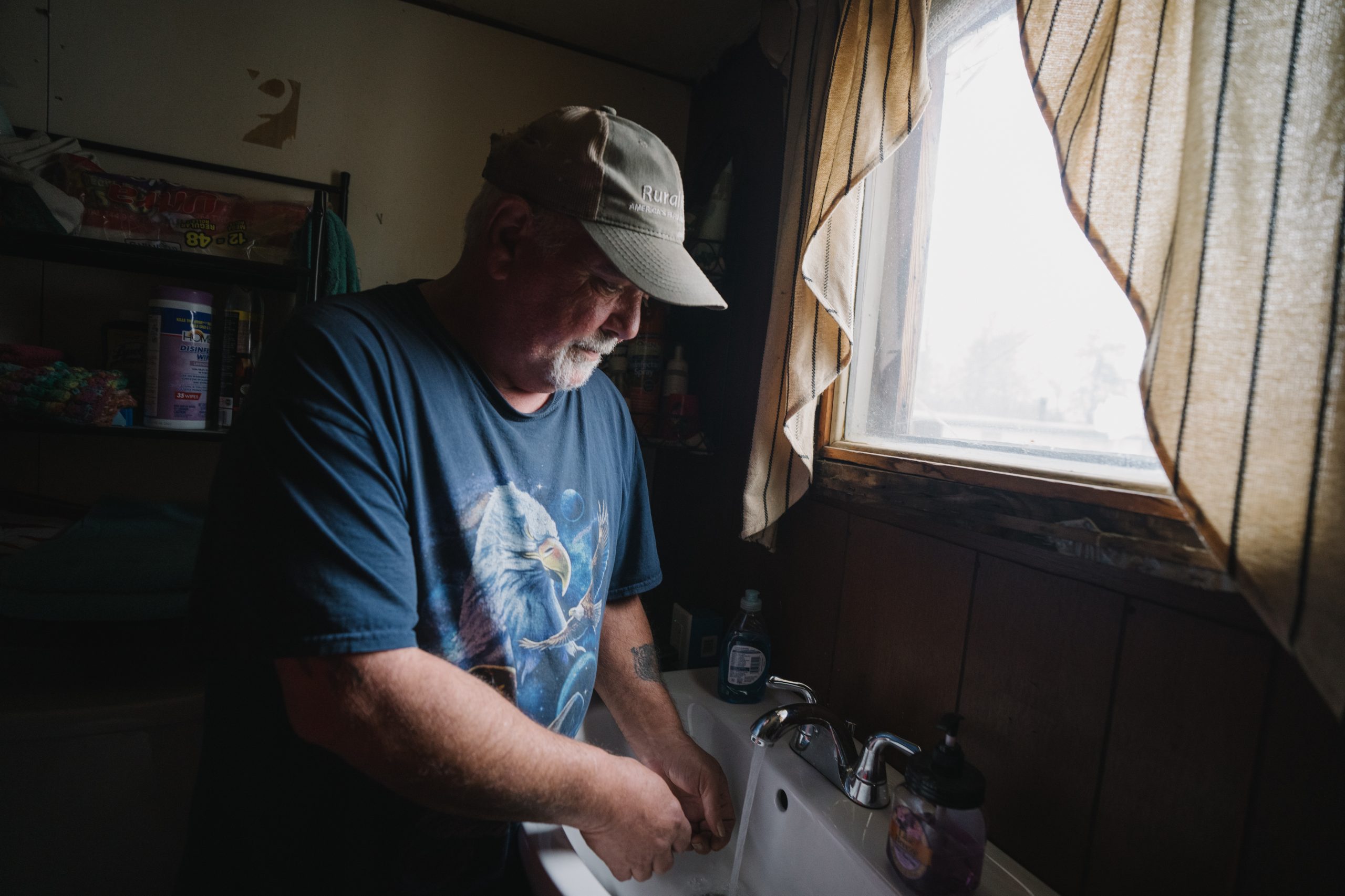
Buril Lowe, of McDowell County, Virginia, stands by his sink that now has clean, running water. Water problems have plagued the county for decades. Photo courtesy of DigDeep
By Lorelei Goff
Donna Dickson’s home sits perched on the mountainside along a winding stretch of Highway 52 in McDowell County, West Virginia. The area is best known as coal country, where generations of stalwart miners harvested the black rock that heated America’s homes, fueled its industrial revolution and westward expansion, and powered allied ships during the second world war.
The area abounds with water. Water flows from rivers and creeks and bursts from roadside springs.
Ironically, it hasn’t always flowed as freely from faucets inside homes along this stretch of highway.
“We always had good water up here, you know, just sometimes we had a lot of problems with the pumps blowing out and stuff like that,” Dickson says. “We just didn’t know when the water was gonna go off on us.”
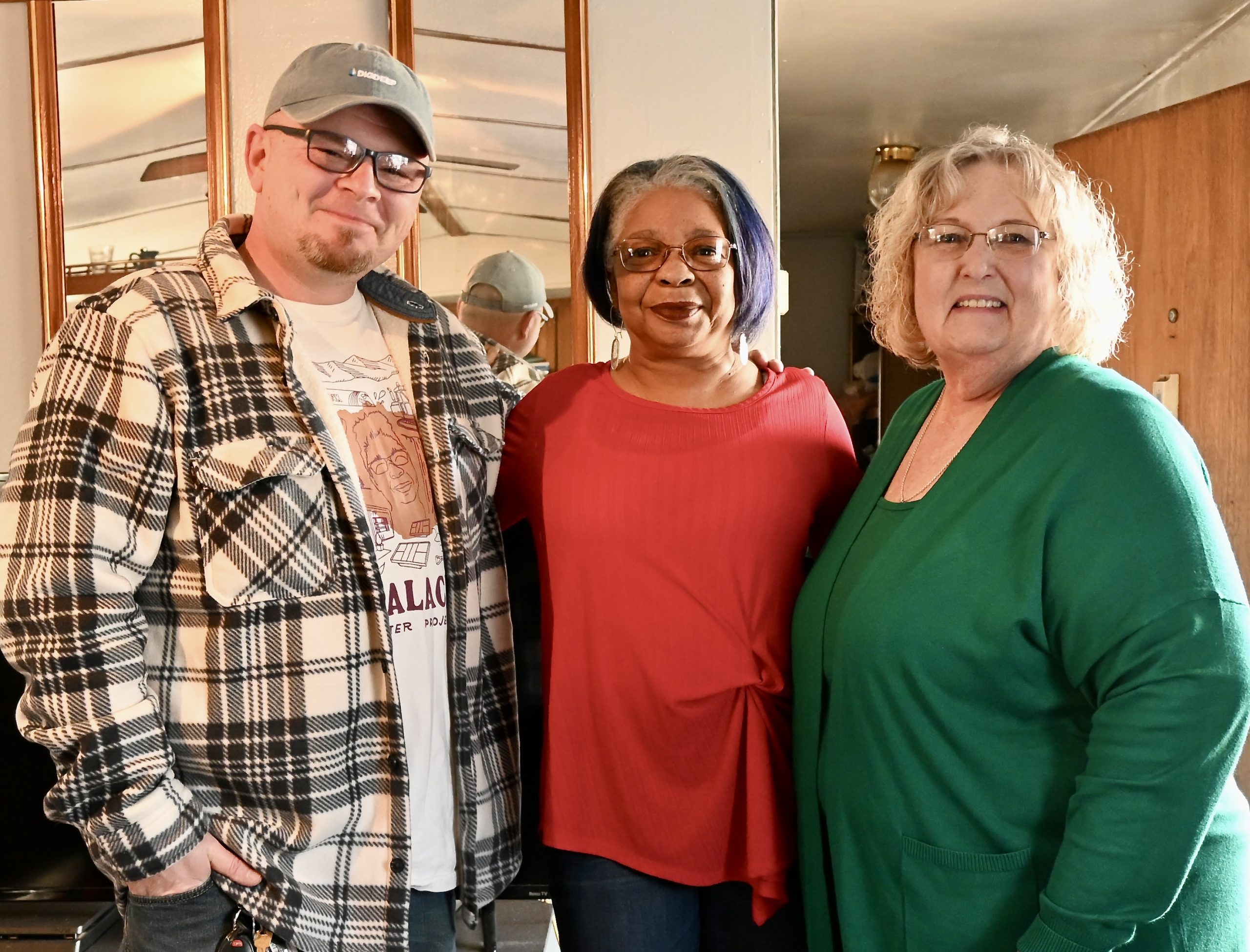
Donna Dickson, center, stands between Edward George, communications coordinator for the nonprofit DigDeep, and Mavis Brewster, general manager of McDowell County Public Service Department. Dickson’s home frequently lost water until efforts by both organizations connected it to MCPSD’s expanded service. Photo by Lorelei Goff
Dickson’s predicament was a snapshot of a much larger problem that has plagued the county for decades.
During the industry’s heyday, coal companies built towns to house miners and their families. That included installing and maintaining pumps, tanks and pipes to convey water into homes. When the companies left, the already-aging water systems were abandoned, handed over to town governments that lacked the money and staff to maintain them, or sold to private water companies that didn’t invest back into them.
Pumps failed. Tanks rotted. Pipes disintegrated. Residents resorted to hauling water from springs and creeks.
In 1990, the McDowell County Public Service Department formed and began acquiring and updating the failing systems. The utility employs 17 people and serves about 3,500 customers through 16 different water systems.
When the department acquired the system that served Highway 52 from a private company in 2006, water outages were frequent and lasted for days. Maps of the county’s pipelines had been destroyed by a flood, making the task of finding and fixing the leaks difficult and, sometimes, impossible.
“We started immediately applying for funding to replace all of it,” says MCPSD General Manager Mavis Brewster.
The funding for the Highway 52 area fell under phase two of the MCPSD’s Elkhorn Water project, completed in December 2021. The project cost $6.3 million. Funding included grants in the amount of $50,000 from the McDowell County Commission, $50,000 from the McDowell County Economic Development Association, $1.2 million from the USDA’s Rural Utilities Service, $1.8 million from the Appalachian Regional Commission, $1.5 million from the U.S. Department of Housing and Urban Development: Small Cities Block Grant program, and $1.75 million from the U.S. Economic Development Administration.
Having to cobble together funding from so many agencies takes time and can get complicated, but according to Brewster, the MCPSD is committed to completing future projects without additional loans, which would raise rates for customers.
“Right now we have 18 different loans with USDA,” she adds. “So every month, with a very limited revenue stream, we’re paying around $34,000 in just loan debt.”
Phases one and two of the Elkhorn Water Project replaced three aging systems and included the communities of Upland, Powhatan and Kyle, moving 112 households onto a new water plant at Maybeury. The project also replaced systems operated by the town of Northfork and the city of Keystone — which had been under a boil water notice for 10 years until the completion of phase two — that serve about 264 households.
But the funding only paid for the mainlines to be laid. The grants can’t be used for lateral lines to connect homes to the mainlines and customers can incur additional costs during construction.
When MCPSD receives funding to construct a new project, those funds can be used to install meter setters and meters for existing customers. If residents sign for service before the construction passes their homes, they are not required to pay a $300 tap fee. If they refuse service and then later decide to connect, they then have to pay the tap fee.
Many residents can’t afford to connect their homes.
Appalachian Water Project
That’s where an innovative nonprofit organization stepped in to assist. DigDeep develops and funds community-led projects to bring clean water into American homes….
Read More: How McDowell County, West Virginia, Is Addressing Its Decades-old Water Problems