


(Bloomberg) — Wall Street grappling with mixed economic data sent Treasuries down, with traders betting the Federal Reserve will signal patience before it decides to cut interest rates this year.
Most Read from Bloomberg
Bond losses were led by shorter maturities as data showed personal spending topped estimates — even as the Fed’s preferred gauge of underlying inflation slowed to an almost three-year low. With policymakers telegraphing they want to see sustainable signs of cooling before lowering borrowing costs, the figures only reinforced bets that a March pivot is still very much elusive.
It’s not that investors have abandoned their bets on an interest-rate cut in the first quarter, but they continued to fully price in a Fed move in May. Of course, that’s all going to hinge upon the next several economic reports, with the impacts from the disruptions in shipping yet to be seen. As Jerome Powell and his colleagues gather next week, traders will be waiting to hear how all that plays out in the balance of risks.
“Expectations remain that the Fed will be discussing ‘when’ — not ‘if’ — to initiate its rate-cutting cycle,” said Quincy Krosby, chief global strategist at LPL Financial. “Unless next month’s collection of inflation-related data underscores decisively that the path toward 2% is squarely in sight, the Fed will most likely wait until May or June to begin easing rates.”
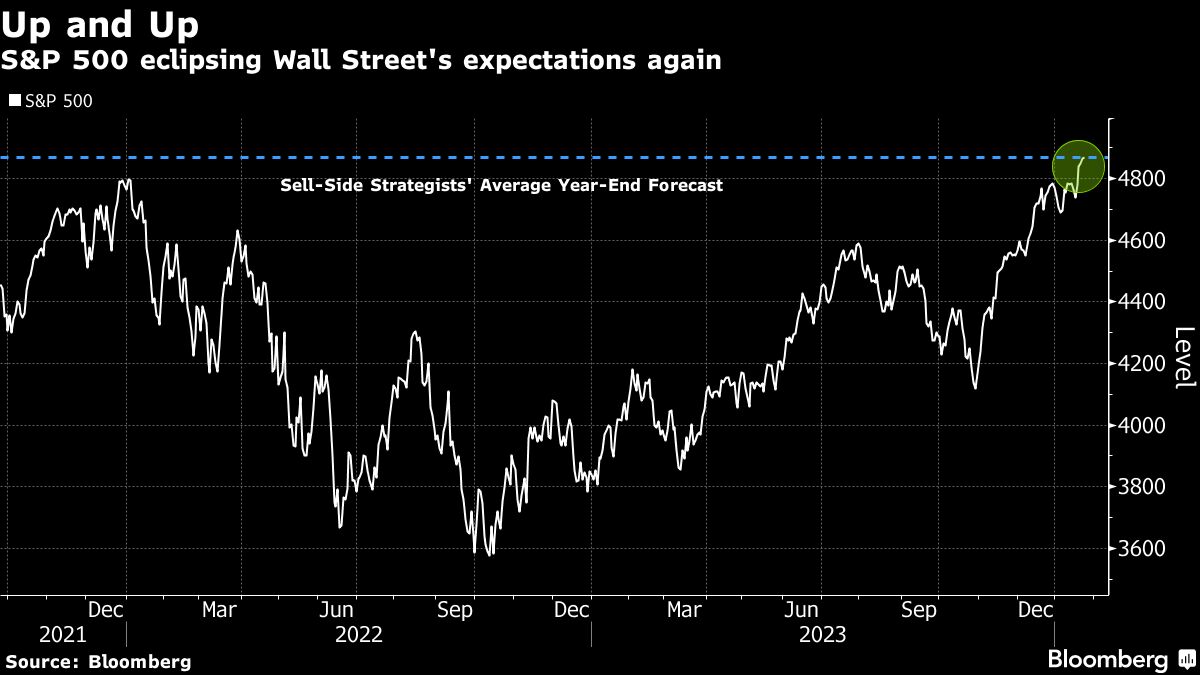
Two-year US yields topped 4.35%. The S&P 500 wavered, while notching a third straight weekly gain. The Nasdaq 100 underperformed as disappointing forecasts from Intel Corp. and KLA Corp. weighed on chipmakers. Oil hit a two-month high after a fuel tanker operated on behalf of trading giant Trafigura Group. was struck by a missile as it transited the Red Sea, underscoring the geopolitical risks to crude supplies.
It’s too soon for US policymakers to call victory as the economy moves from an inflation sweet spot into a more challenging environment ahead, according to Mohamed El-Erian.
The performance of the world’s largest economy in the third and fourth quarters was “remarkable,” El-Erian, the president of Queens’ College, Cambridge, told Bloomberg Television Friday. But “the big risk for the administration is that the economy slows this year because some of the drivers of last year’s growth are no longer there. And, secondly, inflation stops going down.”
“Economic data in the US continues to point to a benign backdrop for markets — with resilient growth, moderating inflation, and the prospect of rate cuts,” said Solita Marcelli at UBS Global Wealth Management. “We expect the Fed to feel comfortable cutting rates starting in May, though this will likely require further signs that the economy is cooling off between now and then.”
The Federal Open Market Committee is widely expected to hold interest rates steady for the fourth straight meeting when it gathers in Washington on Jan. 30 and 31. The real focus though will be on what lies ahead, at the March meeting and beyond.
To Carl Riccadonna at BNP Paribas, the Fed will likely lean against imminent cuts. While a March move can’t be ruled out if the data warrants, he says his base case is for 150 basis points of rate reductions this year — starting in May.
“A faint hawkish bias may remain in the statement, though we admit it will be a close call,” he noted. “If not, we expect the committee to introduce language signaling a patient approach before adjusting policy settings. Recent easing in financial conditions and signs of economic resilience afford the FOMC some time to judge whether inflation is durably converging to the 2% target.”
Indeed, Powell and his colleagues can arguably take their time to start easing policy because they wouldn’t be cutting rates to counteract an economic contraction — as has often occurred in the past. Instead, they would be calibrating policy to reflect a surprisingly steep drop in inflation from a multidecade high 1-1/2 years ago.
“A soft landing seems increasingly evident,” said David Russell at TradeStation. “The big question now is how quickly Jerome Powell will normalize policy when there’s no immediate need. The data matters less going forward and internal conversations at the Fed matter more.”
To Gus Faucher at PNC, the Fed does not need to have inflation at 2% year-over-year to cut rates, but will be cautious given the potential for the tight labor market and strong consumer growth to reignite inflationary pressures. The Fed has further work to do and should not be tempted to declare “mission accomplished,” said Jeffrey Roach at LPL Financial.
“With inflation largely in the bag, the question for the Fed shifts to how to keep it there, and in particular, how far to…
Read More: Bond Yields Rise on Bets Fed ‘Not Rushing’ to Ease: Markets Wrap