Benjamin Sonnenberg.
Wet snow pelts my face and pulls against my skis as I climb above 8,000 feet in the Sierra Nevada of eastern California, tugging a sled loaded with batteries, bolts, wire and 40 pounds of sunflower seeds critical to our mountain chickadee research.
As we reach the remote research site, I duck under a tarp and open a laptop. A chorus of identification numbers are shouted back and forth as fellow behavioral ecologist Vladimir Pravosudov and I program “smart” bird feeders for an upcoming experiment.
I have spent the past six years monitoring a population of mountain chickadees here, tracking their life cycles and, importantly, their memory, working in a system Pravosudov established in 2013. The long, consistent record from this research site has allowed us to observe how chickadees survive in extreme winter snowfall and to identify ecological patterns and changes.
In recent history, intense winters are often followed by drought years here in the Sierra Nevada and in much of the U.S. West. This teeter-totter pattern has been identified as one of the unexpected symptoms of climate change, and its impact on the chickadees is providing an early warning of the disruptions ahead for the dynamics within these coniferous forest ecosystems.
Our research shows that a mountain chickadee facing deep snow is, to borrow a cliche, like a canary in a coal mine – its survivability tells us about the challenges ahead.
The extraordinary memory of a chickadee
As Pravosudov calls out the next identification number, and as my legs slowly get colder and wetter, a charming and chipper “DEE DEE DEE” chimes down from a nearby tree. How is it that a bird weighing barely more than a few sheets of paper is more comfortable in this storm than I am?
The answer comes down to the chickadees’ incredible spatial cognitive abilities.
Cognition is the processes by which animals acquire, process, store and act on information from their environment. It is critical to many species but is often subtle and difficult to measure in nonhuman animals.
Chickadees are food-storing specialists that hide tens of thousands of individual food items throughout the forest under edges of tree bark, or even between pine needles, each fall. Then, they use their specialized spatial memory to retrieve those food caches in the months to come.
Conditions in the high Sierras can be harsh, and if chickadees can’t remember where their food is, they die.
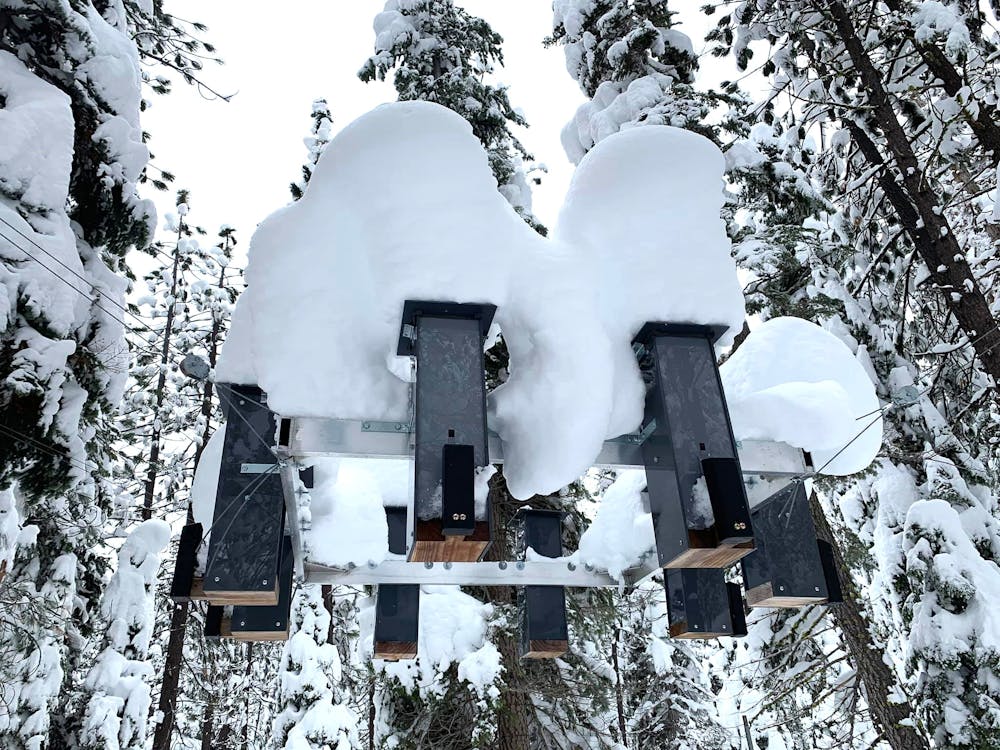
We measure the spatial memory of chickadees using a classic associative learning task but in a very atypical location. To do this, we hang a circular array of eight feeders equipped with radio-frequency identification and filled with seed in several locations across our field site. Birds are tagged with “keys” – transponder tags in leg bands that contain individual identification numbers and allow them to open the doors of their assigned feeders to get a food reward.
The setup allows us to measure the spatial memory performance of individual chickadees, because they have to remember which feeder their key enables them to open. Over eight years, our findings demonstrate that chickadees with better spatial memory ability are more likely to survive in the high mountains than those with worse memories.
However, chickadees may be facing increasing challenges that will shape their future in the high mountains. In 2017, a year with record-breaking snow levels, adult chickadees showed the lowest probability of survival ever measured at our site. This exceptionally extreme winter came with recurrent storms containing cold weather and high winds, making it difficult for even the memory savvy chickadees to forage and survive.
Nevertheless, triumphant populations have persisted in high-elevation mountain environments, but their future is becoming uncertain.
What’s the problem?
“It’s weather whiplash,” says Adrian Harpold, a mountain ecohydrologist. Harpold works to understand variations in climate patterns within forest environments, and one of his field sites lies alongside our chickadee research site.
The Sierra Nevada and other mountain ranges in western North America have been experiencing more extreme snow years and drought years, amplified by climate change. Extreme snow linked to global warming might seem counterintuitive, but it’s basic physics. Warmer air can hold…
Read More: The Chickadee in the Snowbank: A ‘Canary in the Coal Mine’ for Climate Change in