BrianAJackson
In May 2023, Ramaco Resources, Inc. (NASDAQ:METC) announced a major discovery of magnetic rare earth element deposits at its Brook Mine property in Wyoming.
Recent tests conducted by government researchers revealed that the 15,800-acre mineral reserve contains what might be the largest unconventional rare-earth deposit in the country, according to The Wall Street Journal.
In this article, I discuss the importance of METC as a source of Rare Earth compounds. Ultimately they can be refined into metals and formulated as permanent magnets. Importantly, these magnets are used in military and defense weaponry and face restrictions from China.
China banned the export of technology to make rare earth magnets at the end of December 2023, adding it to a ban already in place on technology to extract and separate critical materials.
Rare Earth Industry Dominated by China
In 2023, China announced curbs on critical metal exports in retaliation for Western restrictions on the chip industry. These controls were on gallium and germanium metals and some compounds. For clarity to readers, gallium (“Ga”) and germanium (“Ge”) are not Rare Earth Elements (“REE”), but China has a stranglehold on these critical minerals as it has with Ga and Ge. Because of previously imposed restrictions on REEs in another dispute back in 2010 by China, the similarity is a cause for alarm.
Ten years ago I discussed China’s rare earth dominance in a Nov. 5, 2010, Seeking Alpha article entitled “How China’s Rare Earth Embargo Impacts High Tech Companies.” Thirteen years have elapsed since the article, and in light of expanded applications for REE, an impending China-U.S. trade war, and a very different REE industry outside China, I want to expand and update my analysis of the market.
China was able to dramatically impact REE prices because the country excavated more than 90% of rare earth elements produced in the world at that time in 2010. Then, it acquired nearly all of the ability for processing the rare earth ore into end products.
These processing capabilities include:
- Separating the rare earth ore into individual rare earth oxides;
- Refining the rare earth oxides into metals with different purity levels;
- Forming the metals into rare earth alloys; and
- Manufacturing the alloys into components, such as permanent magnets, used in defense and commercial applications.
In other words, even if there are alternative sources of rare earth minerals mined in the U.S., there are no sizable refineries for converting the rare earths from rock to separated elements.
- Now, roughly 60% of all mined rare-earth minerals are sourced from China. Three other major sources exist in Myanmar, Australia, and Mountain Pass.
- China has come to control 91% of refining activity, 87% of oxide separation, and 94% of magnet production
If China restricts rare earth element (“REE”) exports, it would affect industries worldwide that rely on these elements and applications as shown below in Table 1:
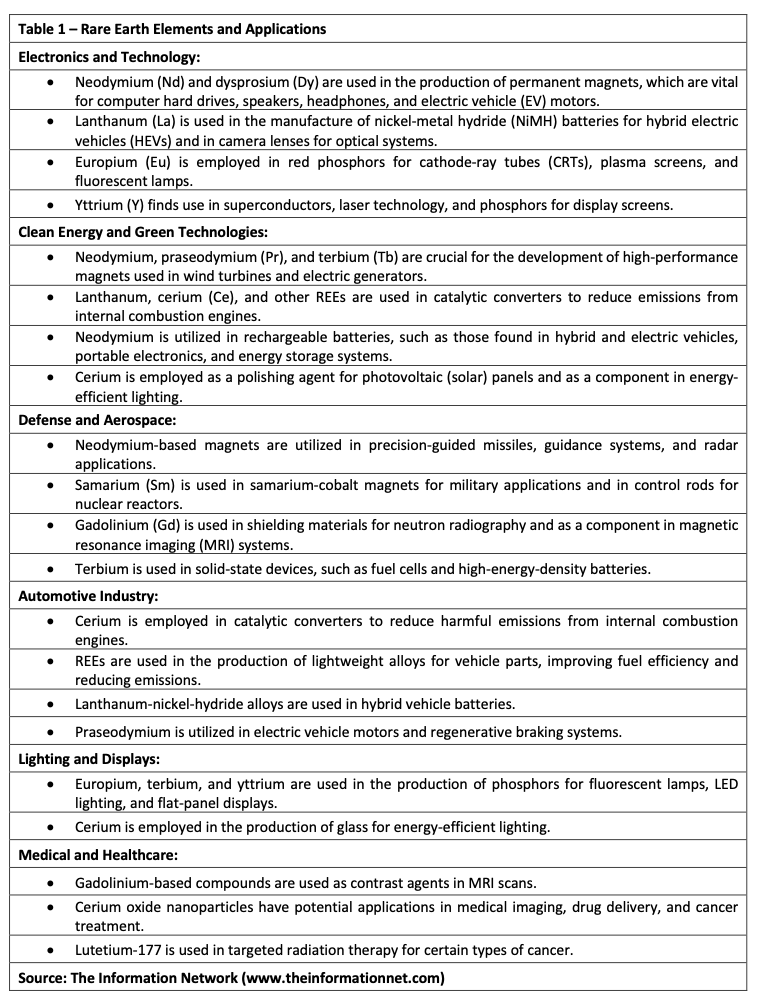
According to The Information Network’s report entitled Rare Earths Elements in High-Tech Industries: Market Analysis and Forecasts Amid China’s Trade Embargo, in 2030 Green Technology applications (EVs, Wind Turbines) will dominate the demand for REEs as shown in Chart 1.
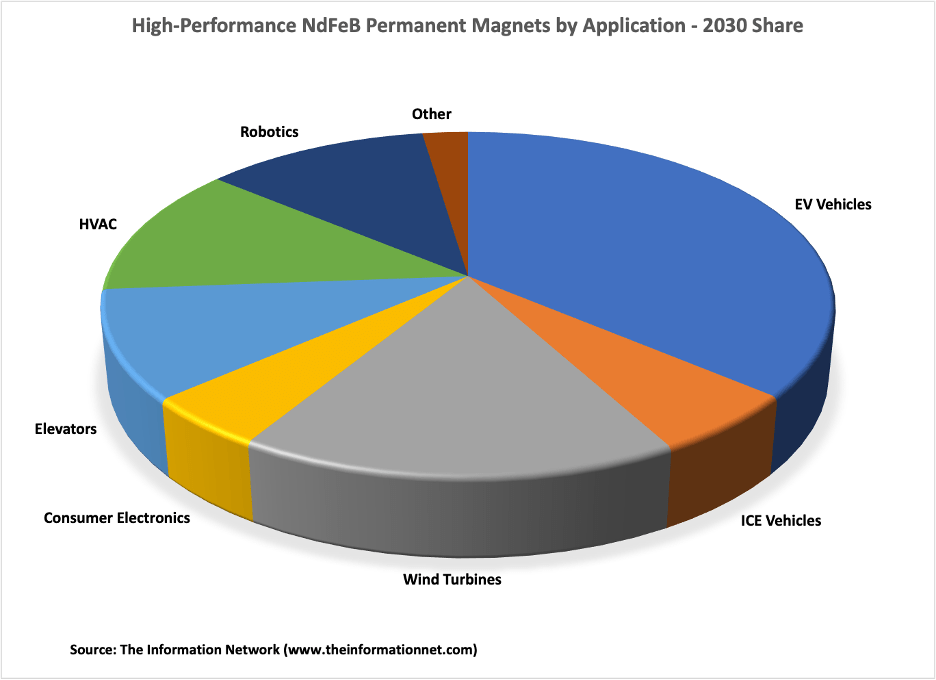
Chart 1
Ramaco Resources, Inc. (METC) – A $37 Billion Mother Lode
Ramaco’s deposits contain both heavy and light rare earths, including neodymium, praseodymium, dysprosium, and terbium. While some elements are in the coal, most are found in clays and carbon-rich materials at the tops and bottoms of coal seams. Coal beds are seen as an unconventional source for rare earths in contrast to traditional hard rock deposits.
Importantly, the inherent “softness” of the clay and other strata surrounding the coal seams suggests that the mined material can be processed in a more cost-effective and environmentally friendly manner compared to conventional REEs. Processing REEs from hard rock minerals like monazite, bastnaesite, and xenotime typically involves intensive crushing, grinding, and the use of highly caustic chemicals and acids.
Initial testing estimates indicate that the Brook Mine site holds approximately 640,000-800,000 tons of in-place 100% total rare earth oxide (TREO). Within this range, about 181,000 to 226,000 tons, roughly 28%, consist of magnetic rare earth elements (REEs) used in power magnets, which I discuss below.
Rare Earth Magnets
Neodymium-praseodymium (NdPr) rare earth magnets, also known as NdFeB magnets, possess exceptional magnetic properties that make them highly sought after for a wide range of applications.
China has a 94% share in the global production of rare earth magnets. China is the only country with operations in all steps of…
Read More: Ramaco: Coal Mining Company That Also Has A Significant Magnetic Rare Earth