Alexandros Michailidis
Investment thesis
My previous bullish thesis about Pfizer Inc. (NYSE:PFE) from October 2023 did not age well, as the stock delivered a -10% total return over the last half-year, substantially lagging behind the broader market. Despite it, today I want to reiterate my bullish thesis because recent developments suggest that the business continues moving in line with its innovative approach and commitment to create value for shareholders. The market seems to be wrong by overreacting to 2023 revenue and EPS decline, which happened due to sky-high 2022 comparatives [due to the mass COVID-19 vaccination across the world] and not due to any secular issues with Pfizer’s business. Furthermore, according to my valuation analysis, the stock is deeply undervalued and currently offers an attractive 6.3% dividend yield.
The current share price of $26.58 is substantially lower than February 2020 levels. All in all, I reiterate my “Strong buy” rating for PFE.
Recent developments
The latest quarterly earnings were released on January 30, when PFE slightly missed revenue consensus estimates and notably missed EPS estimates. Revenue demonstrated a big, over 40% YoY revenue decline for the third straight quarter, which is due to a massive decline in demand for vaccines against COVID-19.
Seeking Alpha
I do not consider a big revenue decline as a secular threat because what happened in 2023 is that the top line just moderated to pre-COVID levels since the pandemic and mass vaccination highly likely was a once-in-a-century. The same applies to the adjusted EPS. Recent quarters were not an anomaly and aligned with pre-pandemic levels. The only outlier is the latest quarter, and I want to pay readers’ attention here. According to the earnings press release, in Q4, two substantial one-off non-cash accounting entries were recorded. These two one-off transactions cumulatively decreased the diluted EPS by $1.9.
Therefore, I would not recommend panicking due to sharp YoY decreases in revenue and EPS. Pfizer just returned to its normal financial performance, and it is reasonable because the massive COVID-19 vaccination of almost the whole world’s population apparently was a one-off event. Moreover, the company’s balance sheet currently looks more solid than before the pandemic. Pfizer had a $12.7 billion cash pile as of December 31. Its $62.6 billion net debt position might seem higher than before the pandemic levels. However, almost half of the current net debt position is explained by a $31 billion debt raised to acquire Seagen.
Seeking Alpha
The upcoming earnings release is scheduled for May 1. Consensus estimates forecast quarterly revenue of $14.2 billion, which is 22% lower than the same quarter last year. The adjusted EPS is expected to follow the top line and decline from $1.23 to $0.54. I expect Q1 to be the last quarter to demonstrate such a massive YoY drop because Q2 FY 2023 already excluded the major portion of COVID-related revenues. This adds optimism to me that Pfizer will likely start demonstrating positive earnings dynamics starting from Q2, which will help to improve the sentiment around the stock.
Seeking Alpha
If we look at the longer-term perspective, the company continues investing heavily in developing new products. According to the drug development pipeline, there are more than 100 hundred new drugs at different phases of clinical trials and more than one-third of them are either at Phase 3 or already pending registration. Therefore, I am highly confident in Pfizer’s ability to sustain a strong portfolio of patents, which is a vital criterion for a biopharmaceutical company’s financial success.
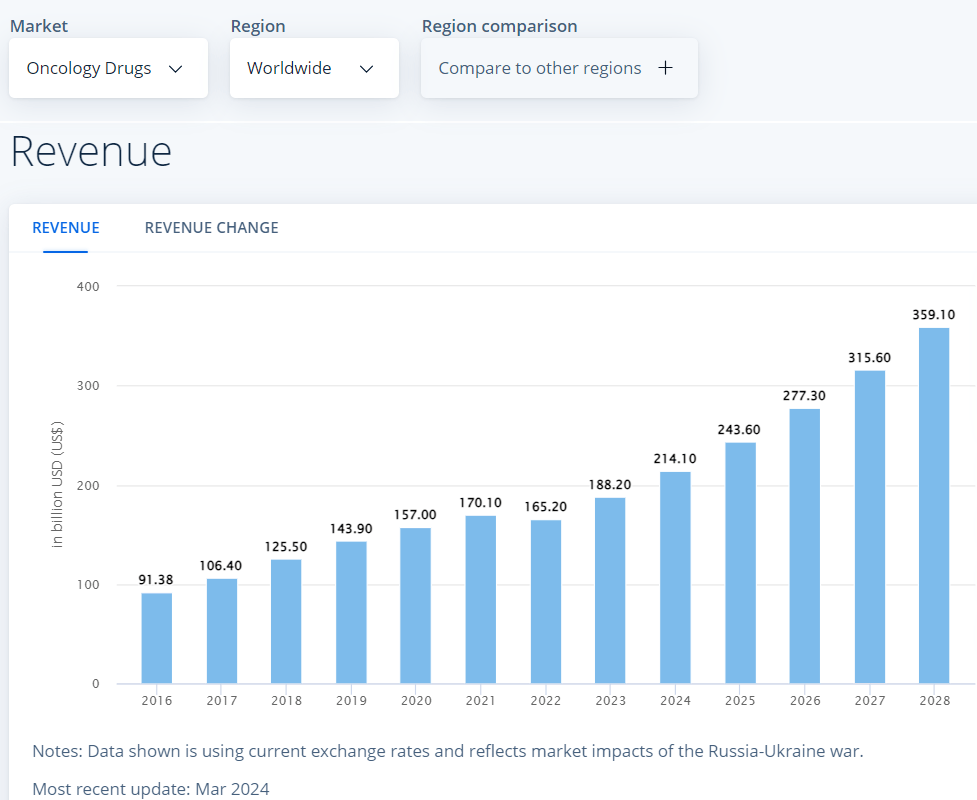
Among products which are at advanced stages of potential FDA approvals, a notable portion belongs to oncology medicine. Apart from the fact that oncology is a big issue due to high mortality rates, I am also emphasizing it because the oncology drugs market is expected to double between 2023 and 2028, according to Statista. Therefore, I consider Pfizer’s focus on expanding its presence in oncology medicine to be a sound move, given solid industry tailwinds.
I also want to emphasize that, according to the pipeline, Pfizer has a drug against Duchenne Muscular Dystrophy [DMD] in Phase 3 of clinical trials. This looks promising because the DMD drugs market is expected to compound at a staggering 33% CAGR over the next decade. Pfizer’s closest mega-cap rivals have not yet secured FDA approval for any DMD treatment. According to drugs.com, most of the DMD treatments FDA approvals were granted to products from Sarepta Therapeutics, Inc. (SRPT). However, Sarepta’s scale is much smaller, and it has much less financial resources than Pfizer. To me, this indicates that…
Read More: Pfizer: The Market Is Wrong (NYSE:PFE)