



Thomas Barwick
Main Thesis / Background
The purpose of this article is to evaluate the iShares Core U.S. Aggregate Bond ETF (NYSEARCA:NYSEARCA:AGG) as an investment option. This fund has an objective to track “the investment results of an index composed of the total U.S. investment-grade bond market”.
It has been a while since I covered AGG, but it is a popular fund that I keep on my radar. It is a low-cost, easy way for retail investors to own a diversified bond ETF filled with investment-grade quality holdings. While this sounds great, it isn’t always a “buy” in my view – even for those who want diversification. In fact, the last time I covered this fund I had a neutral outlook on it. In hindsight, my caution was indeed vindicated:
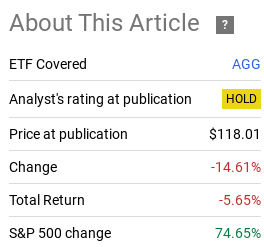
Fund Performance (Seeking Alpha)
While this fund has exhibited long-term weakness, the fact is it has seen some strength in the shorter term. The story of 2024 has been the restoration of positive bond returns, and that includes through vehicles such as AGG:
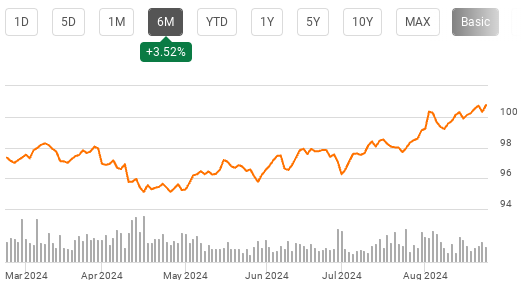
AGG’s 6-Month Return (Seeking Alpha)
Given this positive momentum and the changing macro-environment, I thought it is time to upgrade my outlook for AGG. I see a couple of tailwinds on the horizon and believe investors would be well-served to amplify their fixed-income holdings at this juncture. I will explain why in detail below.
Inflation’s Decline Is The Main Story
The most important topic – in my opinion – that bond investors should usually focus on is inflation rates. This is especially true for IG-rated credit. When we move below quality bonds, than credit risk may be paramount. But for the sectors that make up AGG, which include mostly treasuries, agency mortgages, and high grade corporate bonds, than inflation stats to me impact this fund the most.
With that in mind, it should be fairly clear why I view this fund positively. The inflation metrics that have been coming out recently show figures that are nearing the Fed’s “target” 2% rate. This is a massive shift in headline measures like the PCE, which have fallen well off their highs from 1-2 years ago:
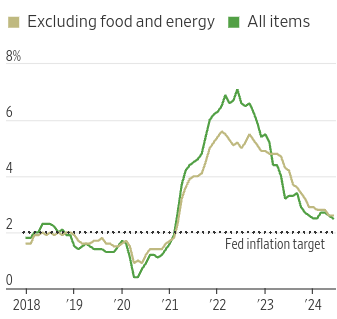
PCE Index (US) (US Commerce Dept)
The impact here is two-fold. One, when inflation declines that means the “real” return of bonds goes up. The reason being that inflation eats away at an investor’s actual return. If one earns a 5% interest rate, for example, but inflation is also 5%, then the real return is 0%. The logic is that inflation has decreased the value of the dollar to the point where an investor hasn’t actually “earned” anything. (Of course, this is still better than a negative return!).
We see this scenario playing out today in that “real” returns are historically high today compared to recent memory:
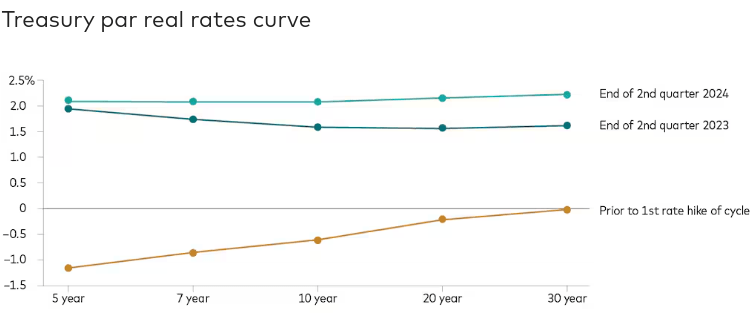
Real Returns (US Treasuries) (FactSet)
What this is showing is the real return from yields after inflation is taken into account is higher now than it was a year ago and before the Fed began its rate hiking cycle. To me this shows the value in treasuries that didn’t exist before – and why I am upgrading my rating on a fund that holds almost 44% of its assets in that treasury bond sector:
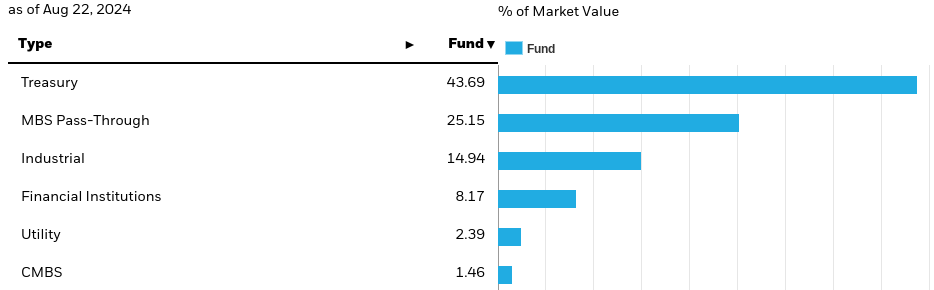
AGG’s Sector Breakdown (iShares)
The second reason why the decline of inflation is important is because of its significance on the Fed’s desire to cut interest rates. If the Fed does begin to lower rates then fixed-income investors are going to likely celebrate. This drives buying into the sector – pushing yields down. But for those who already own the securities, it results in capital appreciation.
And you don’t need to take my word for it. If we look back at past cycles we see that core bond funds (of which AGG is one) tend to perform quite well in the aftermath of the Fed’s first “cut” of the cycle:
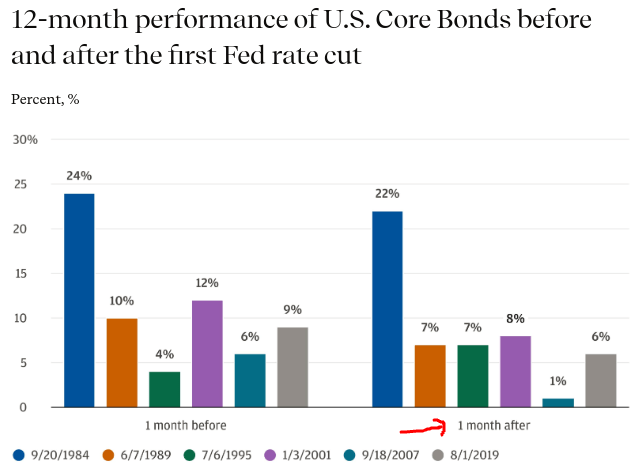
Performance (US Core Bonds) (JPMorgan)
What this all adds up to is that bonds are poised to deliver positive returns in the months ahead. But investors may be running out of time to act. You don’t want to wait until the Fed begins cutting or once yields have hit rock bottom. You want to front-run this in order to lock-in competitive yields and benefit from rising securities prices going forward. Buying an ETF like AGG is one way to do this.
Passive ETFs Are The Rage
Digging deeper into using AGG as an option, I want to point out that retail investors are flocking to these types of products in droves. Clearly, fixed-income investors have a plethora of options at their disposal. They can buy individual issues, mutual funds, CEFs, and, of course, passive ETFs that are multi-sector. AGG falls into that last category and is an extremely popular way to play the bond market.
One reason why that is the case is cost. The passive nature of the fund removes active management fees and it also avoids leverage costs that plague many CEFs. The cost to own this fund is almost…
Read More: AGG: The Window For Buying Bonds Is Narrowing (Rating Update) (NYSEARCA:AGG)