


The Biden administration and Democrats are pushing back against a years-long trend in energy policy that was set in motion by their own former leader.
In tandem with actions aimed at protecting the climate, former President Obama pursued an aggressive policy of natural gas exports — one which President Biden continued for most of his first term.
Early Friday morning, however, Biden — under heavy pressure from many in his own party — signaled a step back, announcing a pause on permits for the segment of the vast fleet of new gas export terminals still awaiting federal permission to build.
During that pause, the president wrote, the administration will “take a hard look at the impacts of [liquified natural gas, or LNG] exports on energy costs, America’s energy security, and our environment.”
Environmentalists, congressional Democrats and communities in the shadow of the export terminals have pushed Biden on the issue, fearing that the gas terminals will fuel an enormous boom in the burning of the planet-heating chemical and undercut renewables, potentially hamstringing attempts to slow climate change.

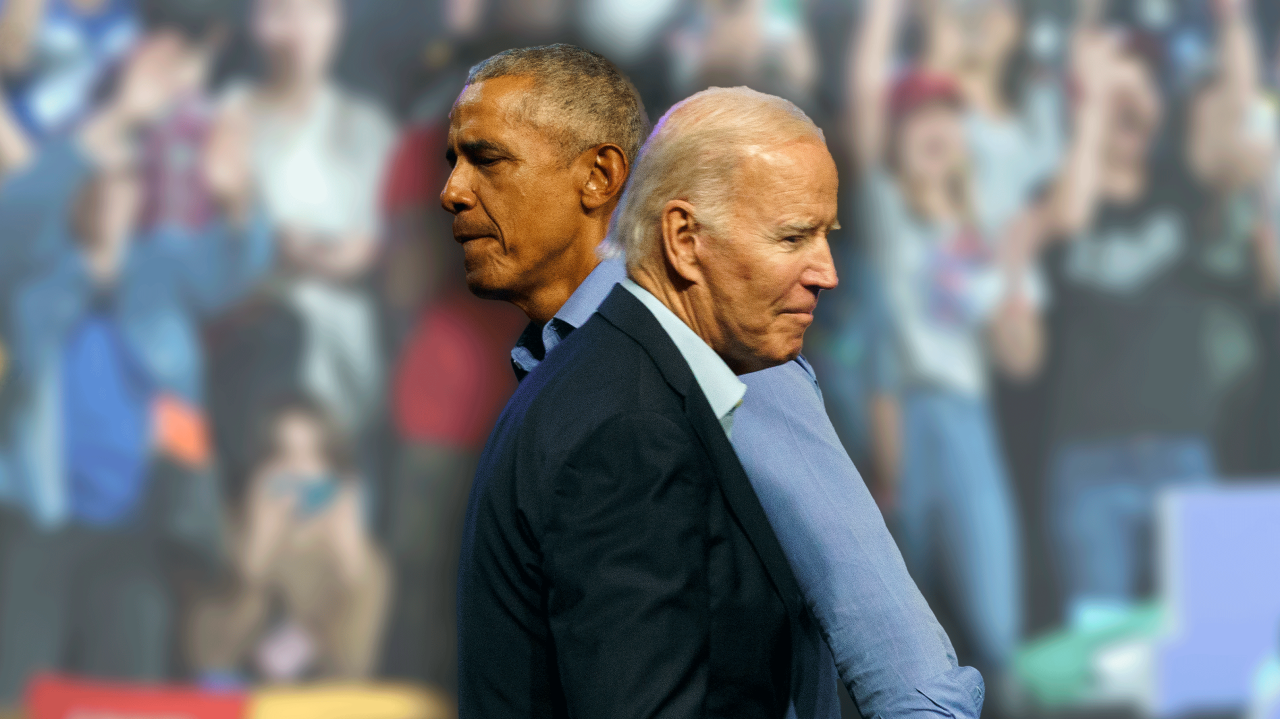
President Biden walks with former President Obama on Saturday, Nov. 5, 2022, in Philadelphia during a midterms campaign rally. (AP Photo/Matt Rourke)
The gas industry contends that because the fuel burns cleaner than coal, the expansion of U.S. gas exports will help the world at large cut emissions — and their restriction will hand the initiative to less responsible actors.
Critics, however, have pointed to findings that even relatively small amounts of leakage from natural gas pipelines can make the fuel as damaging to the climate as coal — findings the industry disputes.
The Biden administration’s decision to implement the pause and review LNG exports’ impacts marks an elevation of critics’ concerns. It also represents a sea change from Obama’s tenure, when the White House didn’t see the themes of climate action and gas boosterism as contradictory, and when the current boom in U.S. gas exports began.
Back then, the White House embraced the idea that gas could be a “bridge fuel” connecting a largely coal-based U.S. power system to a glittering future of renewables — and that U.S. exports of fracked gas could do the same thing for the world at large.
Obama took office amid an epochal boom in U.S. oil and gas that he had inherited from former President George W. Bush. Starting in the second half of the Bush administration, surging gas prices — which spiked sixfold between 2002 and 2005 — helped fund revolutionary new drilling methods that fueled a gas boom.
These shifts had a dramatic effects on the formerly placid world of U.S. gas, which had been largely flat for decades. In 2005 — the year prices spiked — the nation produced about as much gas as it had in 1967.
That changed quickly. By 2008, when Obama took office, gas production had edged up to 13 percent over where it had been in 2005. By the time he left, it was 50 percent higher — and for the first time in history, the United States had a gas export industry.
Top Stories from The Hill
Obama’s team had been bullish on gas since the beginning — with presidential advisor Rahm Emanuel touting increased production on the campaign trail in 2008 as a way to bring “real energy independence” to America.
This independence could be costly for those who lived near the well sites — which sometimes showed up on people’s property whether they wanted them or not. In late 2011, toward the end of Obama’s first term, the Environmental Protection Agency confirmed what people living amongst Barnett and Marcellus Shales had warned of for years: that fracking fouled local water supplies, and over the following decade, numerous studies would also confirm fears over its health impacts.
But Obama told Americans that there was no contradiction between a focus on gas and care for the climate.
In his 2014 State of the Union, he attributed U.S. climate progress to natural gas, saying if “extracted safely” it represented a “bridge fuel that can power our economy with less of the carbon pollution that causes climate change.”
Obama’s reasoning centered on harm reduction. Gas is mostly methane, a fossil fuel that releases only about half the quantity of planet-warming chemicals when burned as coal — as well as far fewer pernicious atmospheric contaminants like sulfur dioxide.
And as gas supplies surged, slashing the fuel’s price, something unprecedented happened: By 2016, gas had replaced coal as the dominant fuel in the American electric sector — by far the most planet-warming…
Read More: Biden bucks Obama’s legacy on climate and gas with LNG export pause