


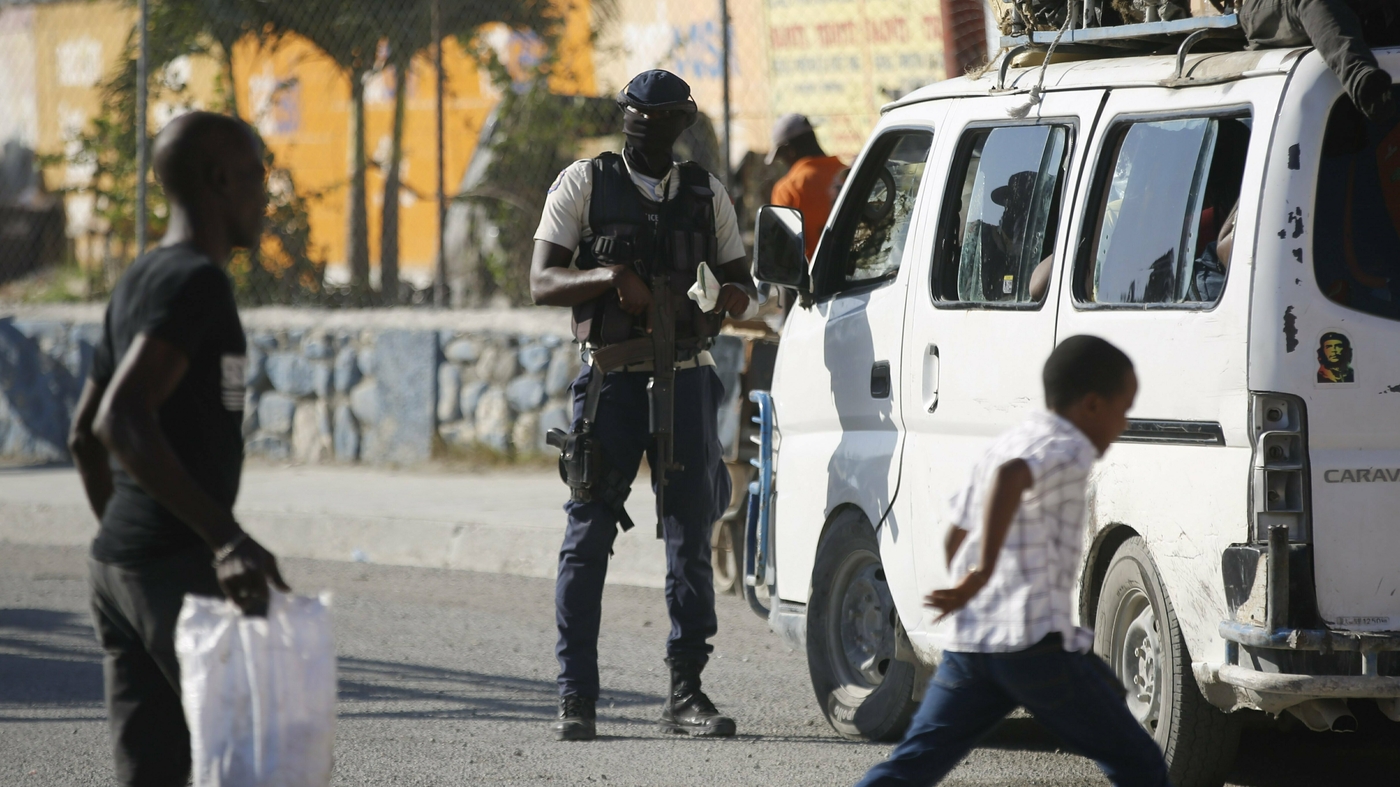

A police officer inspects a public transportation vehicle at a checkpoint in Port-au-Prince, Haiti, Friday, Jan. 26, 2024.
Odelyn Joseph/AP
hide caption
toggle caption
Odelyn Joseph/AP

A police officer inspects a public transportation vehicle at a checkpoint in Port-au-Prince, Haiti, Friday, Jan. 26, 2024.
Odelyn Joseph/AP
PORT-AU-PRINCE, Haiti — Radio stations across Haiti got jammed with calls just hours after a court in Kenya blocked the deployment of a U.N.-backed police force to help fight gangs in the troubled Caribbean country.
Many callers wondered and demanded: What’s next?
Few know.
Uncertainty and fear have been spreading since Friday’s ruling, with violence reaching new records as gangs tighten their grip on Haiti’s capital and beyond.
“Absent a robust external mission that would be deployed very soon, we are facing quite a tragic scenario in Haiti,” warned Diego Da Rin with International Crisis Group.
Gangs that control an estimated 80% of Haiti’s capital have in recent weeks attacked and seized power of previously peaceful communities, killing and injuring dozens, leading to widespread concerns that they will soon control all of Port-au-Prince.
The number of people reported killed last year in Haiti more than doubled to nearly 4,500, and the number of reported kidnappings surged by more than 80% to nearly 2,500 cases, according to the most recent U.N. statistics.
Meanwhile, Haiti’s National Police is losing officers at “an alarming rate,” while those still in service continue to be overwhelmed by gangs, according to a U.N. report released this week. More than 1,600 officers left the department last year, and another 48 were reported killed.
In addition, equipment sent by the international community to help bolster an underfunded police department has crumpled beneath heavy fights with gangs. Only 21 of 47 armored vehicles were operational as of mid-November, with 19 “severely damaged during anti-gang operations or broken down,” according to the U.N. report. The remaining seven vehicles “are permanently disabled,” it stated.
“The situation has gone overboard. Enough is enough,” said a man who identified himself as Pastor Malory Laurent when he called Radio Caraibes to vent about Friday’s ruling. “Every day, you feel there is no hope.”

Lawyers react as Justice Chacha Mwita delivers judgement on a petition against the deployment of Kenyan forces to Haiti, at Milimani court in the capital Nairobi, Kenya, Friday, Jan. 26, 2024.
Brian Inganga/AP
hide caption
toggle caption
Brian Inganga/AP

Lawyers react as Justice Chacha Mwita delivers judgement on a petition against the deployment of Kenyan forces to Haiti, at Milimani court in the capital Nairobi, Kenya, Friday, Jan. 26, 2024.
Brian Inganga/AP
Kenya’s government said it would appeal the ruling. Still, it’s unclear how long that might take and whether other countries who pledged to send smaller forces to boost the multi-national mission would consider going at it alone.
Among those who planned to send forces were the Bahamas, Jamaica, Belize, Burundi, Chad and Senegal.
“All I will say at this time is that this is a major setback for the people of Haiti who yearn to have a stable country to live in,” said Roosevelt Skerrit, Dominica prime minister and former head of a Caribbean trade bloc known as Caricom that has sent recent delegations to Haiti to help resolve the unrest. “The decision of the Kenyan court warrants an emergency meeting of the friends of Haiti to determine with the Haitian people the plan B.”
Bahamian Prime Minister Philip Davis did not return messages for comment, nor did the office of Jamaican Prime Minister Andrew Holness.
Hugh Todd, Guyana’s foreign minister, told The Associated Press that the trade bloc will likely meet soon to discuss the implications of the ruling as it awaits word…
Read More: Haitians are desperate after Kenyan court blocks police force deployment : NPR