


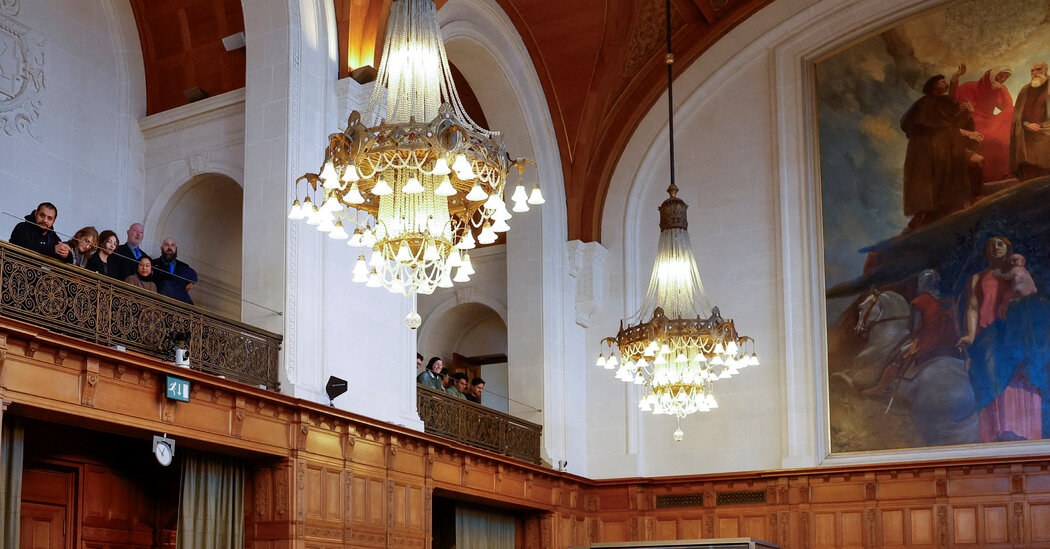
A ruling on Friday by the International Court of Justice on charges of genocide against Israel had deep historical resonance for both Israelis and Palestinians. But it lacked immediate practical consequences.
The World Court did not order a halt to fighting in the Gaza Strip and made no attempt to rule on the merits of the case brought by South Africa, a process that will take months — if not years — to complete.
But the court did order Israel to comply with the Genocide Convention, to send more aid to Gaza and to inform the court of its efforts to do so — interim measures that felt like a rebuke to many Israelis and a moral victory to many Palestinians.
For many Israelis, the fact that a state founded in the aftermath of the Holocaust had been accused of genocide was “one hell of a symbol,” Alon Pinkas, an Israeli political commentator and former ambassador, said after the ruling by the court in The Hague.
“That we’re even mentioned in the same sentence as the concept of genocide — not even atrocity, not disproportionate force, not war crime, but genocide — that is extremely uncomfortable,” he added.
For many Palestinians, the court’s intervention offered a brief sense of validation for their cause. Israel is rarely held to account for its actions, Palestinians and their supporters say, and the ruling felt like a welcome exception amid one of the deadliest wars this century.
“The slaughter is ongoing, the carnage is ongoing, the total destruction is ongoing,” said Hanan Ashrawi, a former Palestinian official. But the court’s decision reflected “a serious transformation in the way Israel is being perceived and treated globally,” she said.
“Israel is being held accountable for the first time — and by the highest court, and by an almost unanimous ruling,” she added.
To Gazans, the intervention will bring little immediate relief.
Israel’s campaign in Gaza has killed more than 25,000 Gazans, according to Gazan officials, and damaged most of the buildings in the territory, according to the United Nations. More than four in five residents there have been displaced from their homes, the health system has collapsed, and the U.N. has repeatedly warned of a looming famine.
In ordering compliance with the Genocide Convention, the court pushed Israel to follow an international law that was written in 1948 and that prohibits signatory states from killing members of an ethnic, national or religious group with the intention of destroying, even partly, that particular group.
To many Israelis, the decision seemed like the latest example of bias against Israel in an international forum. They say that the world holds Israel to a higher standard than most other countries. And to the Israeli mainstream, the war is one of necessity and survival — forced on Israel by Hamas’s attack on Oct. 7, which killed about 1,200 people and led to the abduction of 240 others to Gaza, according to Israeli estimates.
Yoav Gallant, the Israeli defense minister whose inflammatory statements about the war were cited by the court in the preamble to its ruling, called the court’s ruling antisemitic.
“The state of Israel does not need to be lectured on morality in order to distinguish between terrorists and the civilian population in Gaza,” said Mr. Gallant.
“Those who seek justice will not find it on the leather chairs of the court chambers in The Hague,” he added.
Still, the court’s instructions might give momentum and political cover to Israeli officials who have been pushing internally to temper the military’s actions in Gaza and alleviate the humanitarian disaster in the territory, according to Janina Dill, an expert on international law at Oxford University.
“Any dissenting voices in the Israeli government and Israeli military who disagree with how the war has been conducted so far have now been given a really powerful strategic argument to ask for a change in course,” Professor Dill said.
For Professor Dill, the case also prompted reflection “about the human condition,” given how Israel was founded in part to prevent genocide against the Jewish people.
“Preventing human beings from turning against each other is a constant struggle, and no group in the world is incapable of that,” she added.
It was a topic that appeared to preoccupy the sole Israeli judge, Aharon Barak, among the 17 assessing the case on the World Court.
As a child, Mr. Barak, 87, survived the Holocaust after escaping…
Read More: ICJ Ruling Orders Israel to Prevent Genocide in Gaza: Live Updates