


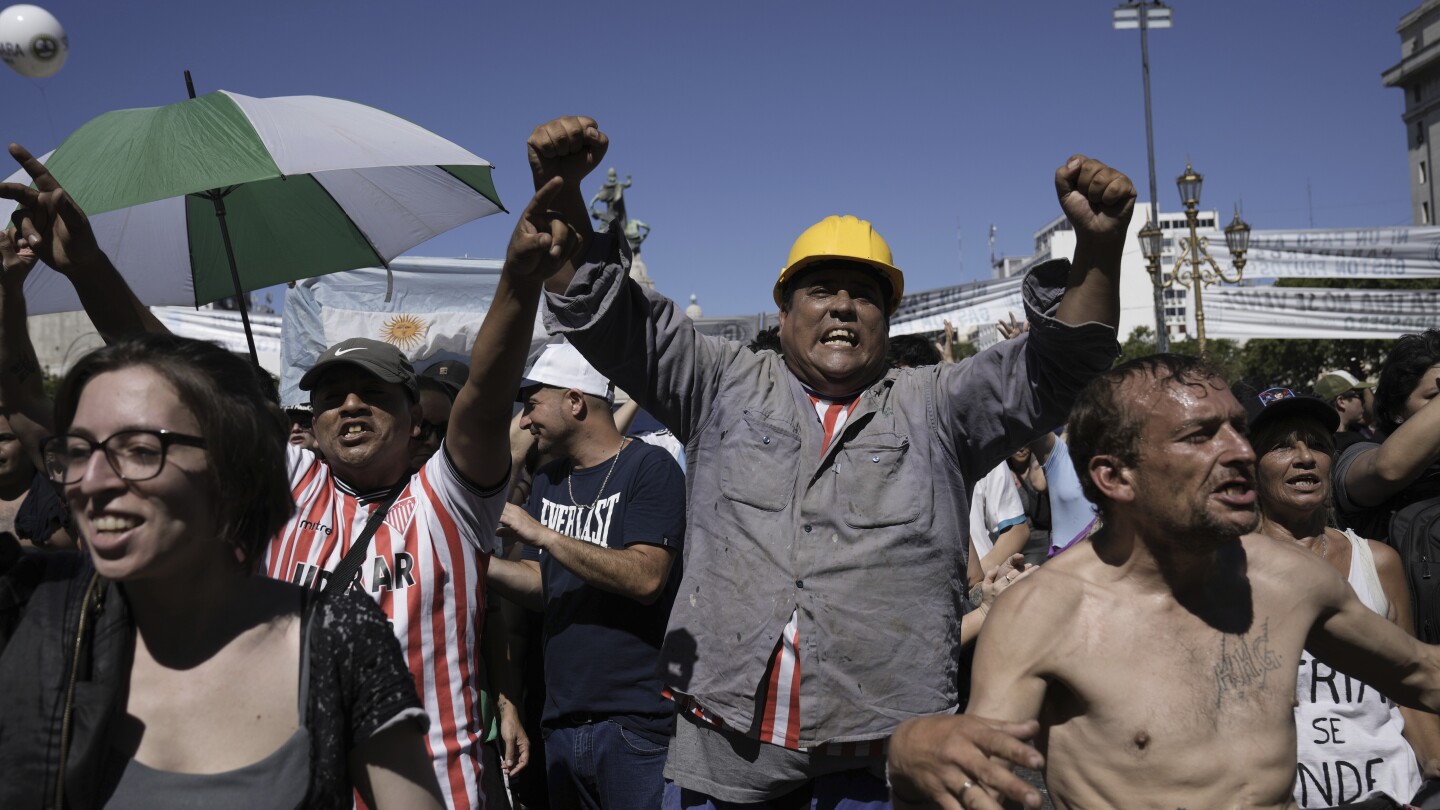
BUENOS AIRES, Argentina (AP) — Argentina’s libertarian President Javier Milei faced a one-day general strike Wednesday protesting his decree targeting unions as well as his proposals for economic and labor law changes, showing that his opponents are wasting no time in trying to derail his austerity agenda.
The biggest union, known by its acronym CGT, organized the strike and was joined by other unions. Strikers took to the streets in the capital, Buenos Aires, and other cities across the country, joined by social groups and political opponents, including the Peronist party that dominated national politics for decades.
Until his presidential run, Milei, an economist, was known mostly for his televised screeds against the political caste, and he secured victory last year by a wide margin and took office just over a month ago. A self-declared “anarcho-capitalist,” he pledged a drastic reduction in state spending aimed at shoring up a government budget deficit that he says is fueling red-hot inflation, which finished 2023 at 211%.
On Dec. 20, Milei issued a decree that would revoke or modify hundreds of existing laws so as to limit the power of unions and deregulate an economy featuring notoriously heavy state intervention. A court ruling has put the labor changes on hold. He also sent an omnibus bill to Congress that would enact sweeping reforms in the political, social, fiscal, legal, administrative and security fields.
As of early evening, Milei had yet to comment publicly on the strike, which was scheduled to end at midnight. It remained unclear whether it would amount to a speedbump to his agenda, or no obstacle at all.
While people have legitimate reasons to complain — triple-digit inflation and a steep devaluation of Argentina’s peso — behind the scenes the main impetus for the strike was the president’s drive to weaken union power, Buenos Aires-based analyst Sergio Berensztein said.
“For union leaders what is at stake is really a lot. If they don’t complain, their bargaining capacity is going to drop dramatically and their influence in politics is going to dwindle,” Berensztein told The Associated Press in a phone interview. “Milei feels quite comfortable confronting these leaders. He’s still very popular; union leaders are unpopular.”
The walkout was Argentina’s first general strike in more than four years, and it was also the quickest ever to be organized in a president’s term since the return of democracy in 1983, according to a review by local media outlet Infobae. Milei’s predecessor, center-left Alberto Fernández, did not face any general strikes.
Read More: Argentina strike: President Javier Milei faces one-day protest