


Sign up for daily news updates from CleanTechnica on email. Or follow us on Google News!
The idea of using plain old gravity to store large amounts of wind and solar energy is not a new one, but the idea of deploying abandoned mines shafts to that effect is relatively recent. The big question is whether or not gravity energy storage can work economically, and mine shafts might just be the answer.
What’s Up (Or Down) With Gravity Energy Storage
Whenever the topic of gravity storage comes up, pumped hydropower is sure to get a mention. The basic idea is to push something heavy — like water — uphill when excess renewable energy is available, and then let it flow downhill to a generating station when the grid needs more electricity.
Pumped hydropower technology is old hat, having been around for about 130 years. The new challenge is that the global economy needs to add a huge amount of storage for wind and solar energy as quickly as possible, which is not a particularly good fit for pumped hydro. These systems are significant pieces of new infrastructure that require money, time, and energy to plan, permit, and build (here’s our complete pumped hydro archive).
The US Department of Energy has been working with researchers and innovators to develop new standardized, modular systems that could help speed up the timeline. The good news is that suitable sites are relatively abundant here in the US and other parts of the world, technically speaking.
The reality, though, is that sites for new pumped hydro facilities don’t grow on every tree. A proposed pumped hydro energy storage project at an existing reservoir in Carbon County, Wyoming has been moving forward, for example, but another pumped hydro proposal on Navajo Nation land along the Little Colorado River is facing stiff opposition.
Expanding The Field Of Gravity Energy Storage
Because energy storage loves a challenge, solutions have been emerging. One approach is to repurpose abandoned brownfield sites instead of flooding out natural habitats and human communities. A pumped hydro project at a former coal field in Kentucky illustrates that approach.
Another strategy involves underground pumped storage projects that avoid the land use issues that can stall out a conventional project. The use of natural rock formations can also help shave down the cost of new infrastructure.
That, in turn, suggests a totally different approach, which is to replace water with a heavy something else, such as rocks or discarded wind turbine blades.
Without dependency on water, gravity systems could be situated just about anywhere something heavy is available.
Gravity storage systems don’t necessarily need to be built underground, but the CleanTechnica ears pricked up when we caught wind of the case for underground systems made by the leading engineering field ABB.
Why ABB Hearts Underground Gravity Storage
Specifically, ABB sees a win-win potential for using abandoned mine shafts to deploy gravity storage systems, because mine owners are thirsty for solutions, too.
“The decommissioning of mine shafts is a costly and time-consuming process for mining companies,” ABB noted in a press release last December.
“By repurposing disused mine shafts for energy storage, mine shafts can fill a productive function for up to 50 years beyond their original lifetime, and can mitigate decommissioning costs, while simultaneously creating new job opportunities and contributing to the green energy transition,” they added.
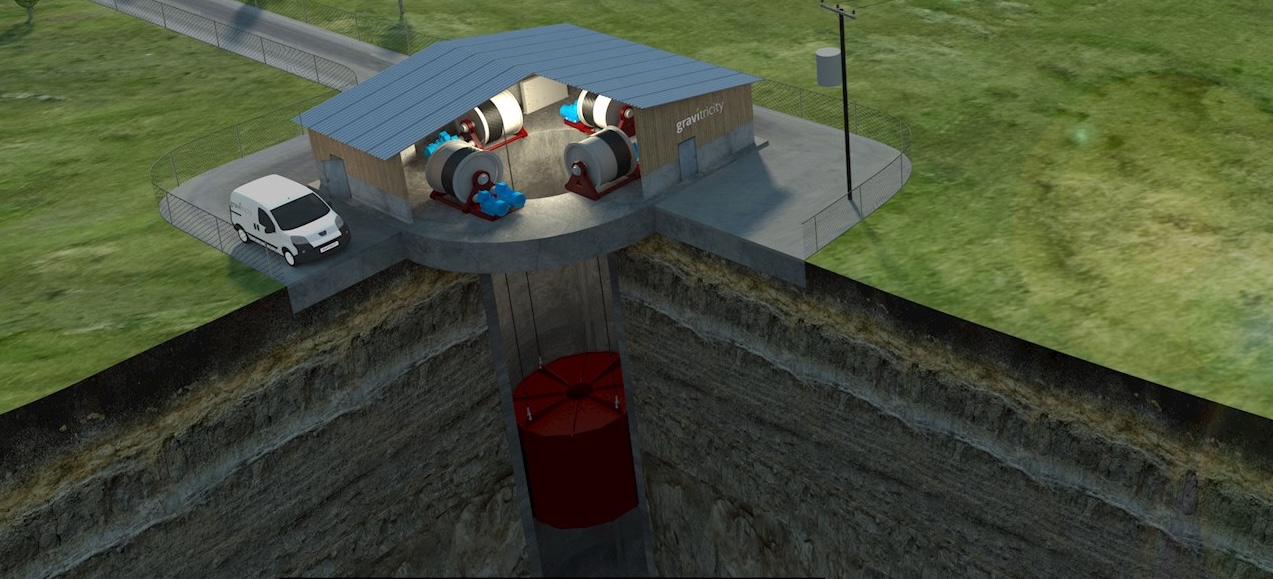
The press release described an agreement with the UK energy storage firm Gravitricity, aimed at leveraging ABB’s expertise in hoisting technology to help Gravitricity speed its “Gravistore” gravity system to market.
“Unlike batteries, the Gravitricity system can operate for decades without any reduction in performance,” ABB enthused. “Gravitricity has already proven the system with a scale demonstrator and is exploring the potential to deploy their groundbreaking technology in decommissioned mines worldwide.”
“As a market leader for mine hoists with a large installed base of more than 1,000 hoist solutions worldwide, ABB will collaborate by providing research and development, product development and engineering teams specializing in the design, engineering and operations of mine hoists and mechanical, electrical and control technologies for hoisting,” ABB added.
“ABB has 130 years of history with mine hoists, since we first electrified one in Sweden in the 1890s, but this collaboration with Gravitricity shows how we can continue to diversify and adapt our technologies,” chipped in ABB’s manager of Business Line Hoisting, Charles Bennett.
More Interest In Underground Energy Storage
ABB is not the only one excited by the prospects of…
Read More: Gravity Energy Storage Has A Secret Weapon Up Its Sleeve