


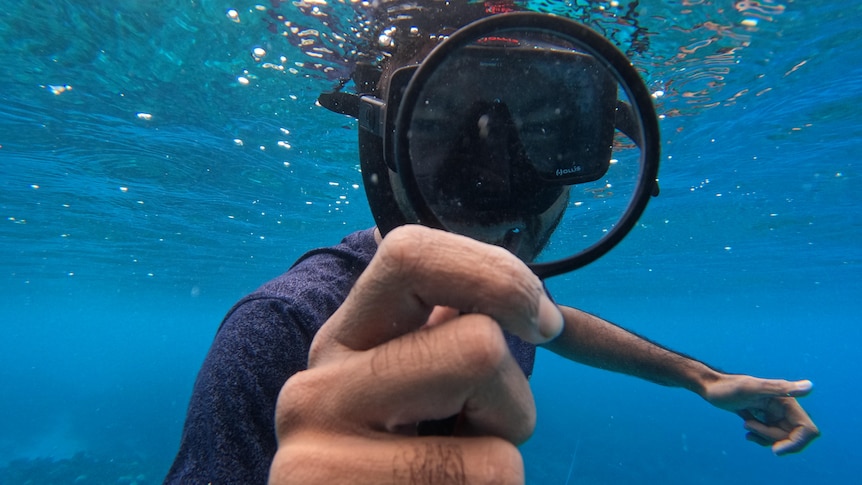
For thousands of years, the people of Ulithi atoll have managed their reef atoll ecosystem using traditional knowledge.
Wedged between Japan, the Philippines, and Papua New Guinea, they’ve used practices like seasonal fishing, taboos, and rituals to maintain a sustainable balance for their marine environment and the people who live there.
“We associate our belief system with sacred areas,” said local, John ‘Magul’ Rulmal Jr.
“That’s steeped in management.”
However, as the outside world pushed in, the Ulithians’ way of life and traditions were thrown off-kilter.
Now, in a unique collaboration with Western scientists, the people of Ulithi are fighting back.
“The basic goal is to live and experience this and share with our children as long as we can,” Magul Rulmal said.
Disruptions to traditions
()
Ulithi Atoll sits on the edge of the Mariana Trench. It’s one of the outer island chains of Yap State in the Federated States of Micronesia.
Four of these islands are inhabited; around 700-1000 people live there surrounded by the deep expanse of the Pacific Ocean.
Songs, stories, dances, and chants codify Ulithians’ traditional knowledge and practices, including fisheries and reef management.
Patrick Nunn, Professor of Geography at the University of the Sunshine Coast, has worked extensively with traditional communities across the Pacific.
He said traditional peoples had not survived for thousands of years by luck.
“They’ve survived by design, and that design is founded in traditional knowledge,” said Professor Nunn.
However, for the people of Ulithi, rapid global changes have made it extremely difficult to adapt these traditions to contemporary challenges.
()
This started during World War II when Ulithi Atoll became a crucial base for the US Navy.
Loading…
Parts of the atoll were dredged, islands were cleared, and new technologies were introduced.
Chief Lazarus Ulith from the island of Fedarai said spearguns, flashlights, and motorboats completely disrupted traditional fishing practices.
This in turn led to problems with their main food sources from the sea.
“It’s a big challenge,” Chief Lazarus said.
“We finally realised that by not enforcing our traditional way of management we were probably overfishing.”
A new way to fight back
Chief Pedrus from the island of Falalop said his people recognised fish numbers were declining, and their reefs were suffering, so they knew they had to do something.
But they’d been scarred by previous interactions with researchers who advised without understanding the cultural context.
They didn’t want to lose their connection to culture and traditions.
“The goal is to use the values that are within these traditions, and then make a paradigm shift — adapt to the contemporary changes,” Chief Pedrus said.
So they invited marine scientist Nicole Crane from non-profit One People One Reef to visit with a few colleagues.
Her background is in marine conservation and supporting traditional communities manage their marine resources.
“My guiding light was to see success in management and conservation through people,” she said.
“Our objectives are to really deeply engage with people rather than say have a meeting with the community and then go do science.
“To understand how people who are ‘of place’ can lead this process, and how those of us who are not ‘of place’ but do have other resources can support that.”
Together, the community of Ulithi and the scientists decided to work together through One People One Reef.
Their goal is to support Ulithians’ way of life — informed both by traditions and data collected by scientists.
“To understand a little bit better the resources and the changes around us, so that we could stay here longer,” said Magul Rulmal, who also jointly leads One People One Reef.
Dr Michelle Paddack, another co-founder, said they were led by the community to collect data on what’s changing and then fed results back.
“So we would share knowledge,” she…
Read More: The remote Micronesian atoll reawakening traditional management, aided by