


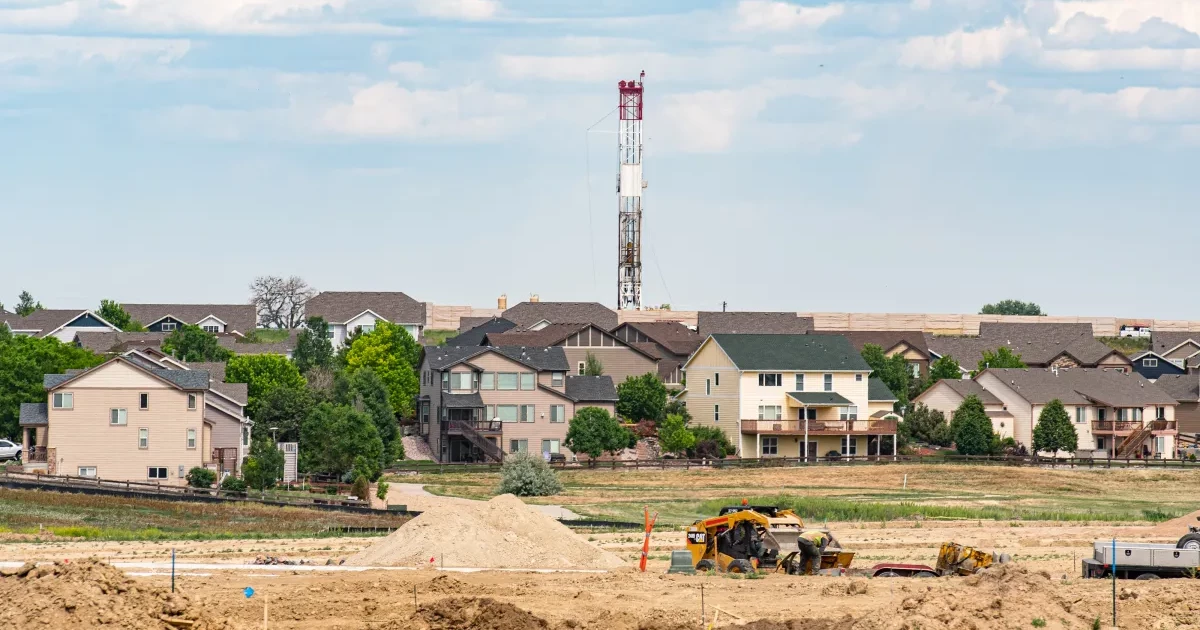
Colorado oil and gas regulators Tuesday passed sweeping rules to deal with the cumulative impacts of drilling and hailed it as “a big step forward,” but legislators, environmentalists and community groups criticized the regulations for failing to protect vulnerable communities.
After a year of hearings and drafts, the Colorado Energy and Carbon Management Commission adopted about 60 pages of rules to assess and mitigate the impacts of oil and gas drilling projects — an exercise the commission was mandated to do by the legislature.
“This has been a herculean effort,” ECMC Chairman Jeff Robbins said. “We have the most protective oil and gas regulations in the nation, and this builds on that foundation. It puts in place even stronger protections for Colorado families.”
Critics did not see it that way. “Doesn’t require any more than is required now and it creates a roadmap for how an operator can drill in disproportionately impacted communities,” said Michael Freeman, an attorney for the environmental group Earthjustice.
These communities are low-income, of color, have vulnerable populations or face disproportionate environmental burdens.
“It’s time we prioritize health,” said Rachael Lehman, environmental justice coordinator for Black Parents United Foundation. “For too long economic impacts have been the only metric for success and been a guiding principle in permitting.”
One major point of contention was a requirement in a June draft that an operator seeking to drill within 2,000 feet of homes in a disproportionately impacted community, or DIC, obtain the consent of every resident.
The provision drew fire from the industry, which argued it could make the development of oil and gas reserves near impossible. It was dropped in the August draft upon which the final rules are based.
That move drew a letter from 22 legislators saying the August draft offered inadequate protections to disproportionately impact communities, failing to meet the goals set by state law.
In 2020, the commission adopted a rule requiring a 2,000-foot setback of drilling from homes and schools, unless an operator added measures that offered “substantially equivalent” protections as provided by the setback.
In the past two years, however, nearly half of the 87 oil and gas development plans approved on the Front Range, primarily in the shale-rich DJ Basin, were within 2,000 feet of homes, according to the ECMC’s annual evaluation of cumulative impacts.
“The commission adopted a setback in 2020 with great fanfare, but they haven’t been enforcing it,” said Freeman, the Earthjustice attorney.
Most drilling will be in disproportionately impacted communities
In testimony during the cumulative impacts hearings, Julia Rhine, an attorney representing Civitas Resources, said “just because of the nature of the DJ Basin and where mineral resources are located … lots of locations, perhaps the majority of locations we believe will be in DICs.”
State Rep. Elizabeth Velasco, a Glenwood Springs Democrat and sponsor of a cumulative impacts and environmental justice law and a signatory of the critical letter to the commission, said the rules fall short of protecting vulnerable communities.
“We did hear that a couple things were addressed around the buffer zones and environmental justice, but there are still things that concern us,” Velasco said. “We have to continue to work on legislation. If they can’t do this through rulemaking we are going to have to have more prescriptive legislation.”
The rules require operators to assess the impacts of their drill sites within a mile of their pads and for water resources up to 2½ miles away, 5 miles if it potentially impacts drinking water supplies.
The problem is that it leases the role of assessing cumulative impacts to oil and gas operators who have no environmental or health expertise but do have a bias, said Heidi Leathwood, a climate policy analyst with the environmental group 350 Colorado.
Leathwood also criticized the decision to limit the scope of the assessment to a mile “despite receiving evidence that fracking emissions are linked to health impacts well over one mile away from oil and gas facilities.”
To mitigate impacts, the rules call for best management practices and enhanced systems and practices — where applicable.
The ECMC will also help the Air Pollution Control Division enforce the division’s methane intensity rule, which puts a limit on emission per barrel of oil and gas equivalent produced.
The rules create the position of community liaison to aid communities with operators and with the commission, as well as stronger requirements for notifications and meetings with the community.
“The procedural measures for…
Read More: Regulators passed sweeping rules to mitigate impacts of oil and gas drilling.