


1 / 7

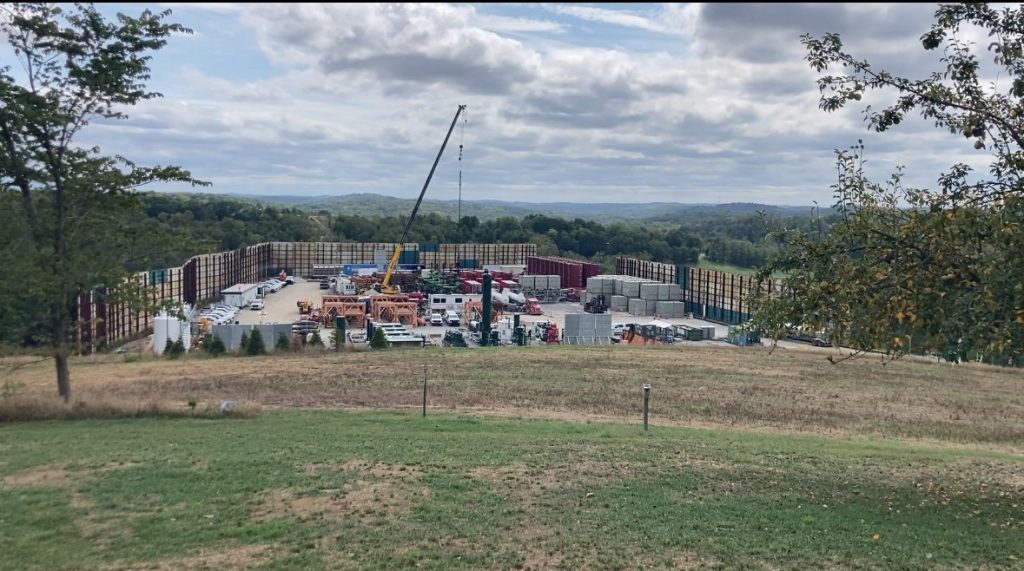
A gas well in South Franklin Township
2 / 7

Center for Coalfield Justice, an environmental justice nonprofit, says it is working for a clean environment in local communities.
3 / 7

A South Franklin Township gas well.
4 / 7

5 / 7

Michelle and Josh Stonemark placed two air monitors in their back yard to monitor air quality.
6 / 7

Jodi Borello of South Franklin Township recorded health issues she and her family have experienced
7 / 7

Jodi Borello is a co-founder of MAD-FACTS (Moms and Dads – Family Awareness of Cancer Threat Spike)
Editor’s note: This is the fourth in a series of stories reflecting on 20 years of gas drilling in Southwestern Pennsylvania.
Twenty years after the first gas well was fracked on the Renz farm in Mount Pleasant Township, Washington County, a body of evidence points to the possible correlation between the drilling technique and health harms, ranging from cancers, respiratory ailments, lower birth weights, and cardiovascular disease.
The industry maintains that drilling for natural gas is safe, but an increasing number of studies suggests that fracking poses a threat to public health, say public health groups and health professionals.
Last October, the ninth edition of the fracking science compendium, which includes more than 2,300 peer-reviewed medical and scientific papers, media investigations and government reports, was released and concluded that fracking poses serious health issues.
Included in the compendium was a set of three studies completed in early 2023 by researchers from the University of Pittsburgh, conducted after dozens of concerned community members in Southwestern Pennsylvania demanded an investigation into the cause of more than 67 rare cancer cases, including Ewing sarcoma, in a four-county area.
According to the PA Health and Environment Study, released in August of 2023, children living within a mile of a well had a five to seven times greater risk of developing lymphoma.
Additionally, people with asthma living within 10 miles of wells during the production phase had a four to five times greater chance of their asthma worsening. And babies whose mothers lived within 10 miles had higher odds of being born underweight and small for gestational age, the study states.
Another study, conducted by Yale University in 2022, showed that young children living about a mile from natural gas wells were two to three times more likely to develop acute lymphoblastic leukemia than children who do not live near a gas development.
“The science is in. Study after study shows fracking can’t be done safely anywhere, including in Pennsylvania,” said Dr. Ned Ketyer, president of Physicians for Social Responsibility Pennsylvania and who lives in Washington County, the most heavily fracked county in the state. “Look, we have enough scientific and medical studies, we have enough data to say fracking is dangerous, and the closer you live to it, the higher the risk to you and your family.”
Pennsylvania is the nation’s second-largest natural gas producer after Texas.
Industry groups, including Marcellus Shale Coalition, a Pittsburgh-based organization for the natural gas industry, dismiss several shale gas studies as ambiguous studies filled with suspect statists used by opponents that “goal-seek the desired conclusions.”
They maintain there is no evidence that fracking harms public health or contaminates groundwater or air, and that natural gas is safely and responsibly extracted.
The coalition said that the Pitt study, in particular, carried “significant flaws, including no new research being conducted nor actual site-level measurements taken,” and pointed out that the study found no link between unconventional natural gas activity and childhood leukemia, brain or bone cancers.
“Protecting the health and safety of our employees, their families, and the communities in which we operate is our highest priority. As an industry rooted in science and engineering, we take objective and transparent research seriously. Research based on actual field monitoring by qualified professionals in Pennsylvania and across the nation demonstrates that natural gas development is protective of public health and the environment,” said David Callahan, president of the Marcellus Shale Coalition, in an email.
“In fact, because of this safe development, increased use of…
Read More: 20 years on, fracking’s potential health impacts eyed