


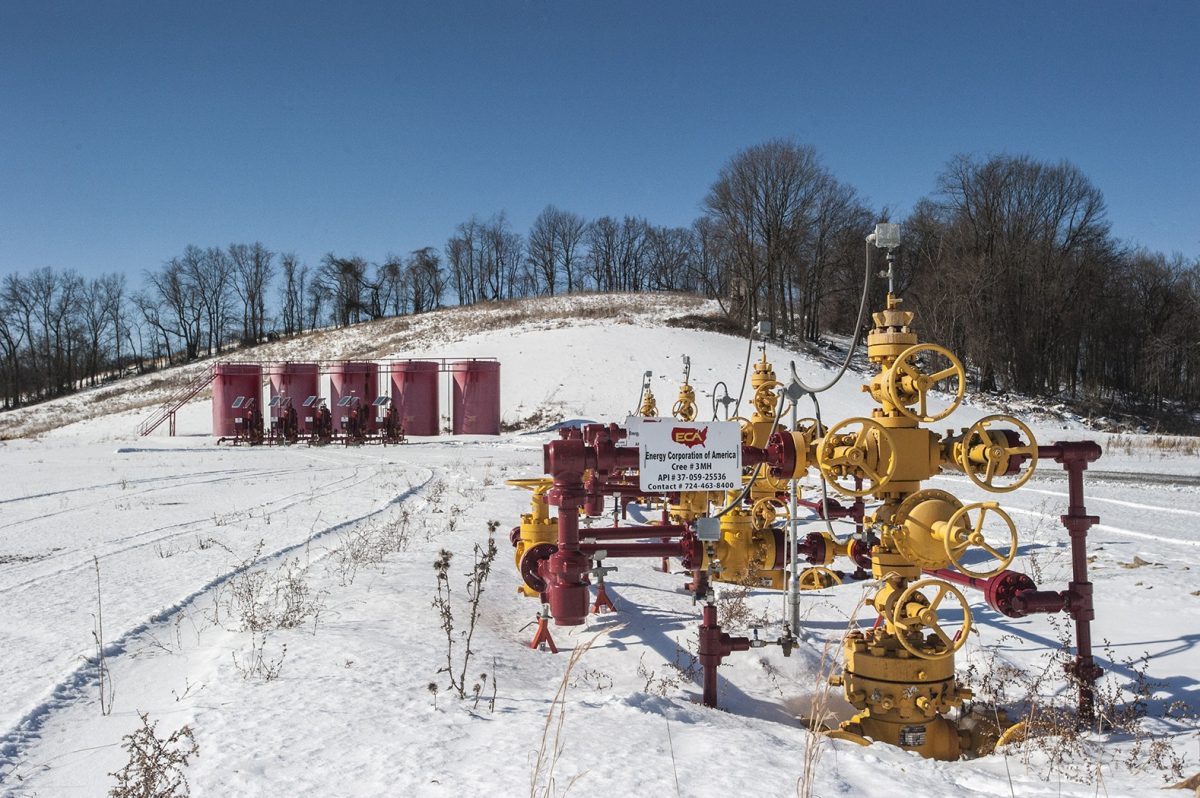
The Cree gas well site in Cumberland Township, Greene County, operated by Energy Corp. of America, is shown in this 2014 photo.
Editor’s note: This is the third in a series of stories reflecting on 20 years of gas drilling in Southwestern Pennsylvania.
Oil and natural gas companies are not the only financial beneficiaries of the Marcellus Shale boom.
“Earning royalties is a nice thing to have,” Mark Caskey said, chuckling.
Caskey is the founder and CEO of Steel Nation, a Southpointe-based company that designs and constructs steel buildings for the oil and gas industry. He also is a savvy family man who has positioned himself, his wife and their two daughters for present and future prosperity.
He secured natural gas rights at two Washington County properties: a 2.2-acre site along Route 19, where Steel Nation previously operated, and a 29-acre tract in North Strabane Township. The parents then set up a 529 College Savings Plan for each daughter, one now a senior at Canon-McMillan High School, the other taking a break from college.
The Caskeys, according to Mark, have devoted thousands of dollars of royalty money to their daughters’ accounts.
Royalties from natural gas production, the state Public Utility Commission states, “are payments made to the owners of mineral rights or overriding royalty interests for the right to extract and produce natural gas from a specific piece of land.”
Usually, a royalty is a percentage of the total revenue from the sale of the gas.
The PUC administers the collection and disbursement of royalty fees and another gas-related benefit: the Act 13/Impact Fee.
Enacted in 2012, that measure provides for the collection and distribution of unconventional gas well fees to municipal and state governments. Most of the funds collected go directly to local governments to cover impacts of drilling.
Caskey said he benefited by waiting a while before pursuing royalties. “A lot of people signed early for lower fees” from oil and gas companies and got less than he did when prices were higher. “All of my neighbors signed late.”
He declined to provide specifics on the royalties, but said the family receives a monthly check and the amounts vary according to natural gas prices. Even when prices are low – as they are now – and checks are not as lucrative, Caskey considers the money to be a windfall.
Royalties, he added, enabled a neighbor to pursue a life of leisure. “A neighbor who loves to fish kept his gas royalties, and was able to sell his farm and move to Erie, where he can fish as much as he wants.”
Impact fees have boosted a number of local municipalities since 2012, especially in the southwestern corner of Pennsylvania. Drilling is commonplace in Washington and Greene counties, which frequently are among the top impact fee recipients in Pennsylvania’s 67 counties. In 2022, Washington was No. 1 in impact fee money received ($9.08 million) and Greene was fourth with $6.5 million. In Fayette, $1.173 million was distributed.
Since the advent of Act 13, Amwell Township leads the way in Washington County with $9.675 million in impact fees. Amwell also was the countywide leader in 2023 ($692,358) and 2022 ($1.17 million).
“We’re not complaining,” said Kathleen Wall, township secretary/treasurer. “This really bailed us out when the fees started.
“Most of our equipment has been updated – we have all model equipment. We’re also able to put money into the bank and try to get as much interest until we need some.”
The fees are valuable to a township that maintains 75 miles of roadway.
Act 13 fees “have been very beneficial to our township,” said Darla Protch, Mount Pleasant’s manager. “Impact fees help fund a lot of public safety projects and public works. They are a big help with our police and fire departments.”
She said the township, where the successful drilling of Renz Well in 2004 precipitated the Marcellus Shale gas boom, is “in the process of hiring a full-time firefighter. When completed, we will be among the few smaller municipalities that have 24/7 firefighting coverage.”
Mount Pleasant, she said, has three full-time and four part-time firefighters.
Chartiers Township has received about $7.2 million in impact fees over time, and manager Jodi Noble is highly appreciative.
“These funds have really helped the township make improvements that we otherwise wouldn’t have been able to do or would have to wait to do.”
She said the township has spent about $4.4 million to pave or improve 17 miles of roadway, $770,000 on public safety and $413,000 on parks and recreation and environment.
“This helps to mitigate impacts to our roads, which get beaten up, and helps with capital projects,” Noble said.
For each of the past five years,…
Read More: Marcellus has wealth of natural gas and more