


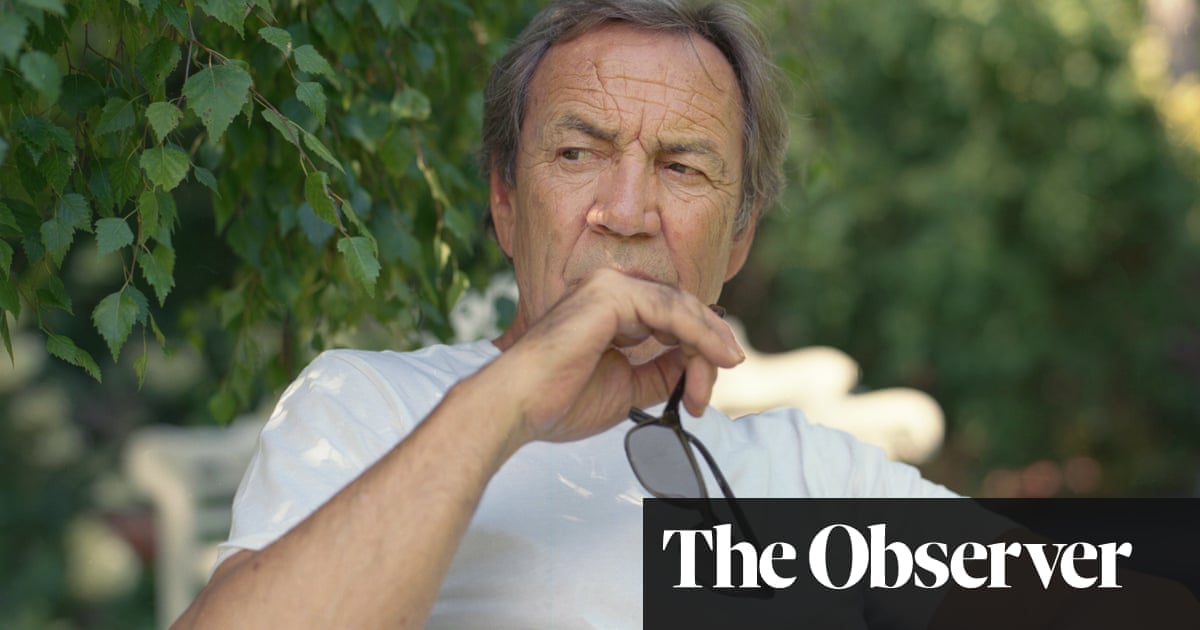
I find Robert Lindsay – I almost trip over him – on a pavement outside Marylebone station just across the street from the hotel where we are to meet. Oh dear. I never know what to do in these situations. Should I feign short-sightedness, and make my way smoothly to the air-conditioned atrium where a discreet table has been booked for us by a publicist? Or should I take the risk and introduce myself now? In the end, I decide there’s nothing for it. We’re practically eye-balling; he might recognise me later and wonder why I scooted past so rudely. Also, he looks kind of anxious, his bag at his feet, his hands patting his pockets. Maybe he’s lost, and needs me to rescue him?
But, no. What I take for anxiety is merely the slight shiftiness of the 21st-century smoker. “Just let me have a cigarette,” he says, once I’ve explained who I am. “Do you mind?” He takes three quick drags – the action is darting and delicate, like a swan going after breadcrumbs at the park – and chucks what’s left in the bin. Then we cross the road together, his hand tight on my upper arm, the better to keep us safe from all the taxis and Deliveroo men. “Ah!” he exhales. “I’m so glad we decided to meet here, and not [at this point, a slight adjustment in the voice] in King’s Cross…” Marylebone, he tells me, is extremely convenient because he lives in Gerrards Cross in Buckinghamshire, and this is where the London train tips him out. Later, I look up Gerrards Cross. It sounds luxe. It gets a namecheck in a sketch from the very first episode of Monty Python’s Flying Circus, and also in a song by prog-rock band Jethro Tull.
At our table, he asks for a pot of tea, and I carefully take him in. It’s rather a splendid sight: full head of hair, navy knitted shirt, cream not-quite-linen trousers, English brogues. He looks smooth, dandyish. Although he’ll gently complain about his age (he is 74), bemoaning the fact that for the first time in his life the prospect of doing seven theatre shows a week is exhausting (he’s in talks about playing Prospero in The Tempest), I can’t take any of it very seriously. To my eyes – I’m old enough to have grown up with him – he’s more or less unchanged. Lindsay has always had a very particular energy as an actor; his fortes are neuroticism, menace and a certain kind of Pooterish thin-skinned-ness; in musicals, he is a trouper par excellence. And this zing is palpable now. His manner is eager, confiding, a bit gossipy. If some of his stories are a touch burnished at this point, they’re also wildly entertaining. Put it this way: we both laugh at his punchlines.
Lindsay is one of several actors who have joined the cast of James Graham’s BBC series Sherwood for its second series (among the others are Stephen Dillane, Monica Dolan and David Harewood). Given the huge success of the show’s first outing, it’s a gig that is both a gift and something of a responsibility for anyone involved. But for Lindsay, the job has a special resonance. Sherwood is set in a small town in Nottinghamshire, an area painfully divided during the miners’ strike of 1984-85 (many men in Nottinghamshire and nearby Derbyshire continued to work, in the face of ostracism and sometimes much worse in their communities), and this happens to be territory he knows well. He grew up in Ilkeston, on the border of the two counties, and as a boy was taken to a miners’ holiday camp – Butlin’s was too expensive – by his trade-unionist father. Sherwood was always going to be irresistible to him; this, he tells me, is the first time in a long career that he has ever been able to deploy his own accent for a role.
But what is his own accent? Since drama school, the voice has been RP, his crisp consonants and elongated vowels adopted ostensibly at the insistence of a voice tutor, who said he would need it for Shakespeare, but perhaps also for reasons that have more to do with social class than with art. “You’ve made me say it,” he’ll tell me, when I push him on this. “If I’m being really honest, yes, it was a class thing. I wanted to be a little better than where I came from.” For a moment, he sounds almost startled by this semi-revelation. “I was told I could be other people [with RP]: that the world would be my oyster, that I could play a thousand characters – and that’s what I’ve always said about it, that it was just for acting. But you’ve opened my eyes to something. Yes, I wanted to be approved of, I think, to elevate my position…”
Read More: Actor Robert Lindsay on his role in Sherwood and growing up in a mining town: