


Imagine hopping on the bus, to be told by the driver that they’re expecting low passenger numbers today – so you’ll have to pay a higher fare to cover the costs. You begrudgingly agree, pay, and board the bus, only to find it’s completely full.
Now imagine this happens not just once, but every day that week. You and the other passengers paid more than necessary, while the bus company ends up making higher-than-normal profits.
It turns out, something similar is happening behind your gas bill.
Gas bills are made up of a combination of different charges, with one of the largest being network costs. These make up 40% of a typical gas bill, and over 60% in South Australia, Tasmania and Queensland.
Gas networks, like electricity networks, are considered natural monopolies. Regardless of which retailer customers choose, they don’t have a choice in the physical gas infrastructure they can connect to.
There is a risk that monopolies abuse their market power and force consumers to pay higher prices. To manage this, many gas networks in Australia are regulated by the Australian Energy Regulator (AER). Every five years, the AER determines the charges that gas networks can pass through to their consumers. These charges are set in a way that allows networks to recover their costs and make a reasonable profit allowance, set by the AER.
There are also a range of incentives that allow networks to exceed that profit allowance. These are intended to encourage activities that result in long-term efficiency improvements, benefiting consumers.
IEEFA recently undertook a simple piece of analysis, comparing the actual profits that regulated gas networks in Australia have made against their profit allowance. If the regulations were working as expected, we’d expect actual profits to roughly align with the allowance, or to exceed it by no more than 30%.
However, we found they were 90% higher than their allowance. In other words, actual profits were almost double allowed profits.
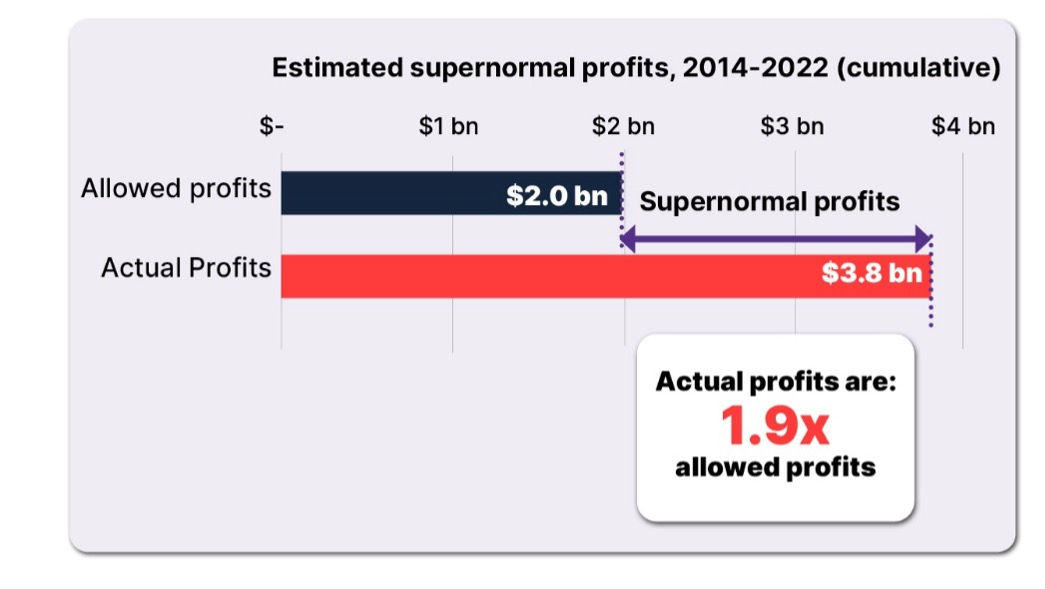
Source: IEEFA. Data includes all fully regulated gas networks.
The economic term to describe this difference is ‘supernormal profit’. Over the period we analysed, 2014-2022, regulated gas networks made $1.8 billion in supernormal profits, on top of their $2 billion profit allowance.
What does this mean for consumers?
Like all regulated gas network revenue, supernormal profits are extracted directly from consumers’ bills. We estimate that they add 5% to a typical gas bill. However, as we don’t know how these profits are divided across individual gas networks, this could well be higher for some consumers.
What’s driving these excessive profits, and who benefits?
By anyone’s measure, making profits that are 90% higher than the regulator-approved allowance is an extraordinary outcome. However, given the incentive structures baked into gas network regulations, this raises the question: have these extraordinary profits corresponded to extraordinary long-term benefits for gas consumers?
Our report used data from the AER to understand what was driving supernormal profits.
The largest driver by far, was an effect termed ‘revenue over-recovery’. In other words, gas networks are making more revenue than expected. A 2023 review of gas distribution networks by the AER revealed that this has occurred in every year since at least 2011.
Actual gas distribution network revenue vs forecast (target) revenue
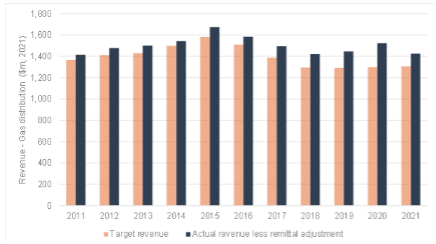
Source: AER.
To understand how this happened, we have to go back to the fact that gas networks are very large, asset-intensive businesses. The cost to maintain them is relatively fixed; it doesn’t decrease significantly if customer demand is low.
Setting fair charges for consumers to access the gas network is therefore a balancing act. To decide what a fair price is every five years, the networks must submit a forecast of how many customers they expect to serve, and how much gas they expect to deliver. The AER then scrutinises this forecast and factors into it into its final pricing decision.
If the forecast proves accurate, the cost of the network is fairly spread among consumers, and networks will make their expected revenue. If it’s wrong, networks will make less or more revenue than required.
Nobody can predict the future, so there is inherent risk in this process – in some years revenue might be higher than expected, in others, lower.
This risk is borne by gas networks themselves, who are regulated under a ‘price cap’ approach. This means that once their prices are set at the start of each five-year period by the AER, there are no adjustments to compensate for years where networks make more or less revenue than expected.
However, since at least 2011 gas networks have never experienced the downside to this…
Read More: Australians overpaid $1.8 billion to gas networks – now they’re being asked for