


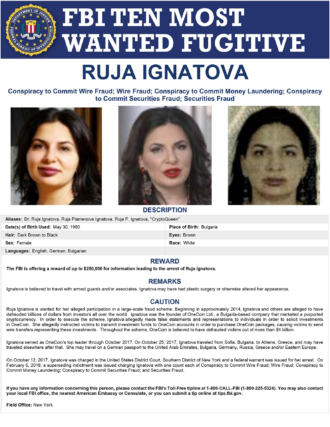
In the spring of 2015, accused Bulgarian cryptocurrency fraudster Ruja Ignatova was amassing a fortune by selling fake digital currency.
The entrepreneur had recently founded OneCoin, a Sofia-based firm that purported to issue a cryptocurrency that she declared would be “the number one” worldwide. International investigators would later link it to a $4 billion pyramid scheme with more than 3.5 million victims around the world.
As she was getting ready to launch her business in the U.S. and potentially entice more unsuspecting investors, Ignatova and some of her associates settled in Dubai, the United Arab Emirates’ financial hub.
There she incorporated shell companies and opened bank accounts to receive and allegedly launder money wired from OneCoin investors. She set up and managed a hair- and body-care salon called Kings & Queens with two of her OneCoin associates, documents obtained by the International Consortium of Investigative Journalists show. She listed as company offices two units in a building near Dubai Marina. And she used a Dubai shell company to buy a $2.7 million penthouse apartment on the top floor of a skyscraper overlooking Palm Jumeirah, an archipelago of artificial islands in the Persian Gulf, according to the documents reviewed by ICIJ.
Now newly leaked confidential Dubai land records shine a light on the role Dubai plays for criminals and suspects such as Ignatova and her cronies, many of whom are serving lengthy prison sentences or are on the run from international law enforcement. Ignatova, who called herself the “Cryptoqueen,” went missing in 2018 shortly after U.S. authorities issued a warrant for her arrest.
The Dubai records were obtained by the Center for Advanced Defense Studies (C4ADS), a Washington, D.C.-based nonprofit organization that analyzes data on transnational security matters. C4ADS shared the data with ICIJ and more than 70 media outlets as part of the Dubai Unlocked investigation coordinated by the Organized Crime and Corruption Reporting Project (OCCRP) and Norwegian financial outlet E24.
The property records at the heart of Dubai Unlocked come from multiple leaks totaling more than 100 datasets, mostly from the Dubai Land Department, plus publicly owned utility companies.
The new investigation by the International Consortium of Investigative Journalists and more than 70 media partners, led by the Organized Crime and Corruption Reporting Project, shows how one of the Middle East’s most exclusive real estate markets became a hot spot for ill-gotten wealth. The data was obtained by the U.S. nonprofit Center for Advanced Defense Studies and shared with Norwegian news outlet E24, then ICIJ and other partners.
Taken together, the leaked property records, mostly from 2020 and 2022, provide a detailed overview of hundreds of thousands of properties in Dubai and information about their ownership or usage. Economists at the EU Tax Observatory and Norway’s Centre for Tax Research who analyzed the data estimated foreign-owned residential properties in Dubai were worth $160 billion in 2022.
ICIJ and its partners used identifying information — such as names, nationalities, dates of birth and passport numbers — to confirm ownership. Reporters also obtained the deeds for some of the properties from the Dubai Land Department. A second tranche of property and transaction data from Dubai reveals additional information about the buying and selling of properties as well as rental incomes.
Dubai Unlocked is part two of a cross-border investigation into Dubai real estate purchased with illicit funds. ICIJ did not participate in part one of the project, Dubai Uncovered, published in May 2022.
The most recent dataset is dated 2022 and has information on Dubai property owners, from wealthy businesspeople and family members of prominent politicians to most-wanted criminals.
Many members of the international reporting team (but not ICIJ) previously analyzed Dubai’s 2020 land data and found that property owners included more than 100 members of Russia’s political elite, public officials or businesspeople close to the Kremlin, as well as dozens of Europeans implicated in money laundering and corruption cases.
According to the Dubai records and other corporate filings reviewed by ICIJ, in March 2015, Ignatova set up a Dubai company called Oceana Properties Ltd. and used it to buy the luxurious 5,303-square-foot flat in the Oceana Pacific building where she officially resided.
In 2017, as the U.S. Justice Department sought to indict her on fraud and money laundering…
Read More: Leaked Dubai property files link luxury flats to OneCoin crypto scammers