


- By Bernd Debusmann Jr
- BBC News, Washington
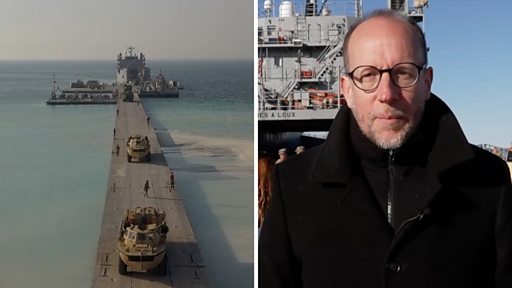
Watch: US military footage illustrates Gaza pier plans
A US plan to deliver aid to Gaza from a floating pier at sea will be fraught with potential logistical and security challenges.
More than 1,000 US troops are expected to participate in the operation although the Pentagon says there will be no “boots on the ground”.
To help achieve that, the US has partnered with a little-known private firm, Fogbow, which is run by former military and intelligence officials.
The goal is to deliver aid equivalent to two million meals a day to Gaza, where the United Nations has warned that famine is “almost inevitable” without urgent action.
Here’s what we know about this huge logistical exercise.
How will the US set up the pier?
US Army vessels set sail on Saturday and Monday to take equipment to the Mediterranean. According to the Pentagon, the plan includes two main components which need to be assembled – a big floating dock made up of steel segments and a two-lane, 1,800ft (548m) causeway and pier.
The causeway will be composed of interconnected, 40ft (12m) steel pieces linked together and attached to the shore.
Cargo ships deliver supplies to the dock and the aid is then offloaded onto a range of barges and smaller vessels – known as logistics support vessels, or LSVs – and taken to the pier.
From there, vehicles will drive the supplies onto land and into Gaza.
The causeway will be assembled at sea and “driven” into the beach, allowing US forces to avoid setting foot on Gaza. The US is supporting its ally Israel and has designated Hamas a terrorist organisation.
This amphibious building project – officially known as Joint Logistics Over-the-Shore, or JLOTS – is one that the US military has used before in Kuwait, Somalia, Haiti and Central America for disaster relief missions.
Earlier versions were used as far back as World War II following the invasion of Normandy on D-Day. As recently as July last year, the defence department used similar JLOTS equipment during a large-scale exercise in Australia.
“The military’s preference, of course, is to have an operating port. That makes everything much easier,” Mark Cancian, a retired US Marine Corps colonel with experience planning amphibious operations, told the BBC.
“But that’s not always possible, either due to a conflict situation or in a peacetime, humanitarian mission,” he added. “That’s where JLOTS comes in.”
What is Fogbow and what role will it play?
Fogbow is led by Sam Mundy, a former Marine Corps lieutenant colonel who previously commanded forces in the Middle East, and Mick Mulroy, a former CIA paramilitary officer and assistant secretary of defence for the Middle East.
The full details of what they will be doing has not been made public before. But a person familiar with the plan told the BBC that the Fogbow operation – known internally as Blue Beach Plan – is primarily to organise the movement of aid after it arrives on the Gaza shore.
The containers will be emptied and the contents put on trucks to be taken to distribution points further into Gaza, as part of a plan approved by the US and Israeli governments.
The floating dock could look like this one built in a training exercise in Australia
The BBC has been told that Fogbow is still looking for funding and has briefed a range of European and Middle East governments on the plans. In the longer term, Fogbow plans to set up a donor-run foundation to help funnel aid into Gaza.
How will security be handled?
Military experts say the plan’s success is dependent on security, both from the possibility of hostile fire in a still-active combat zone and from large crowds of civilians gathering on the shore.
Retired Rear Admiral Mark Montgomery, a 32-year veteran of the US Navy with experience delivering humanitarian aid, said that the operation requires a “security cocoon” to be established both on the beach and in the shallow water nearby.
“You cannot have civilians getting on the pier,” said Mr Montgomery. “They could be a parent desperately looking for food for their children – or they could be trying to kill somebody. That would shut down operations.”
Two people familiar with the plan told the BBC that the Israel Defense Force (IDF) will run “outer” security to prevent crowds of civilians reaching the beach and to make the area safe. The distribution will be the responsibility of local, unarmed Palestinians.
Image source, Getty Images
Palestinians line up for food from aid organisations
Fogbow is expected to have only limited logistics roles and will not be involved in distribution.
While the Pentagon has said no US troops will set…
Read More: How the US military plans to construct a pier and get food into Gaza