


The Good, the Bad, and the Ugly?
By Wolf Richter for WOLF STREET.
Employers added 275,000 employees to their payrolls in January. Over the past three months, they added 794,000 employees or on average 265,000 per month, according to data from the Bureau of Labor Statistics today. These increases are at the upper edge of the increases before the pandemic. But they’re not spread equally across the economy.
Some sectors have surged to new highs, such as construction. Others are plateauing at very high levels, such as Manufacturing and Professional & Business Services. But others are heading lower. Retail has a structural problem. Information, where many tech and social media companies are, dropped sharply, but in recent months re-added jobs hand over fist. And then there’s oil and gas extraction: US production has soared, making the US the largest producer of crude oil and natural gas in the world. But employment around drilling rigs is a fascinating phenomenon. And we’ll look at all of them.
In total, business and government entities added an average of 265,000 employees per month over the past three months:
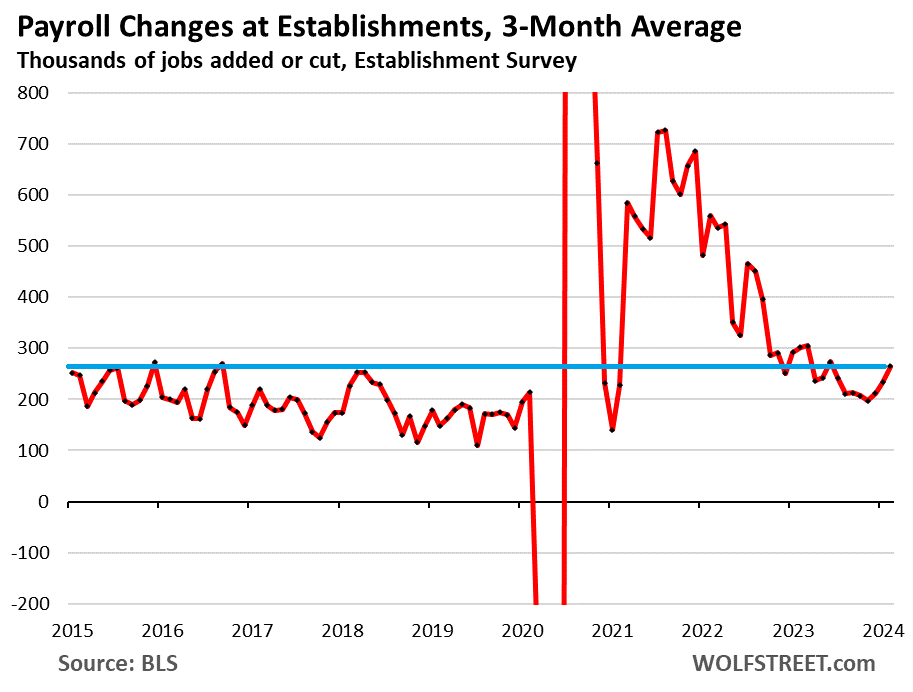
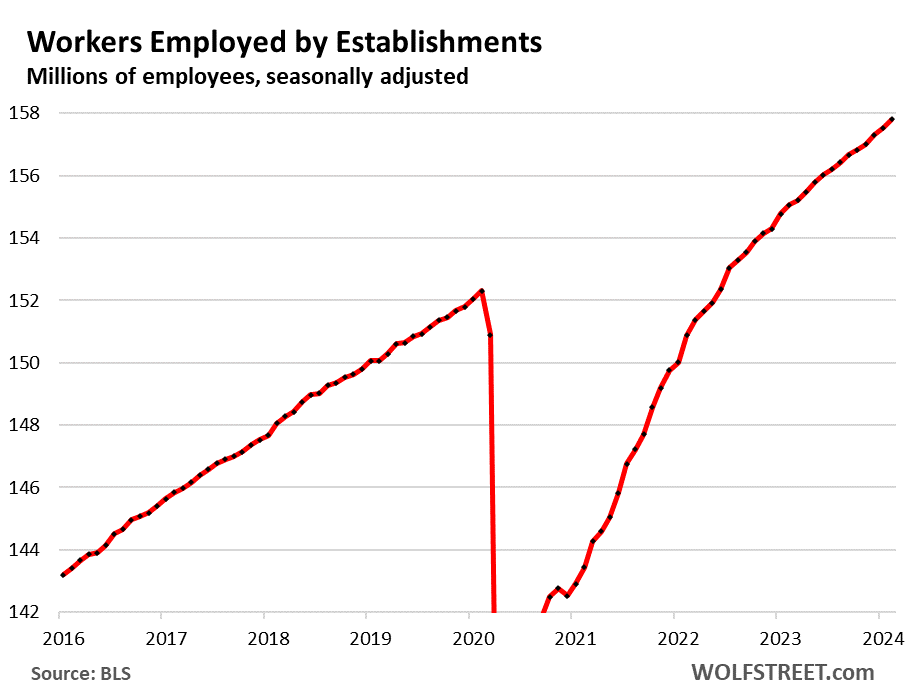
This brought total payrolls to 157.8 million, up by 2.75 million from a year ago.
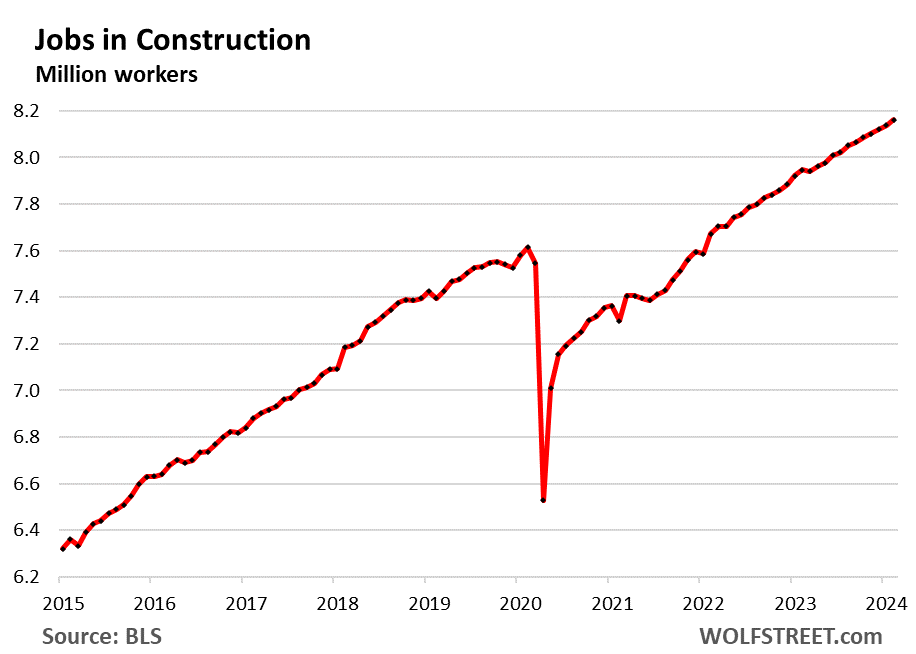
Construction, from single-family housing to highways. We have watched how homebuilders are maintaining sales by cutting prices and buying down mortgage rates, and they’re building at a solid pace. And we’ve been amazed by the eyepopping boom in spending on factory construction. And overall construction payrolls surged to another all-time high:
- Total employment: 8.16 million, new record.
- 1-month growth: +23,000
- 3-month growth: +60,000
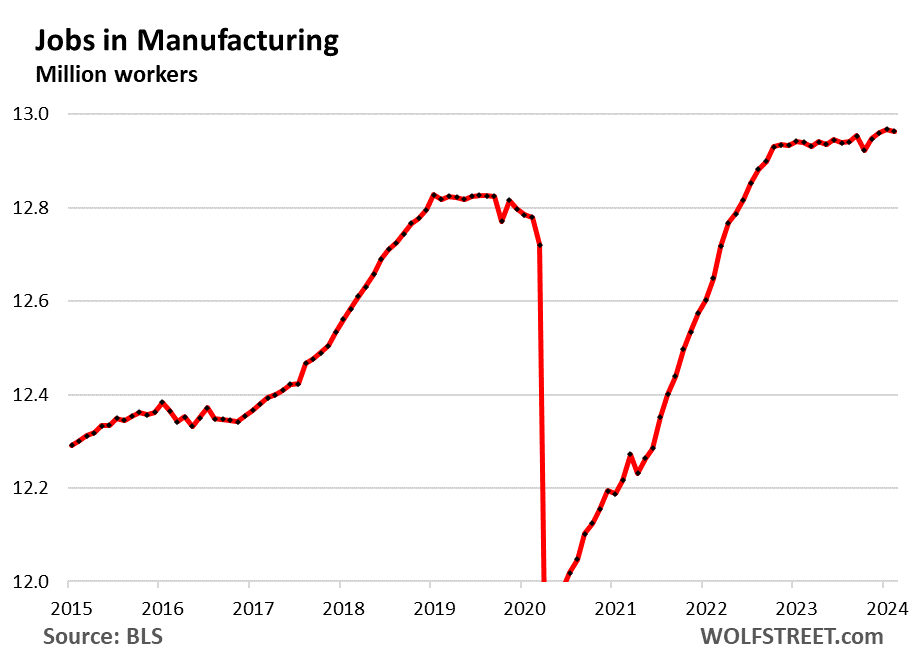
Manufacturing: Employment has formed an upward slanted high plateau for a year after the post-pandemic employment boom. Strikes are occasionally putting a dent into it, but when the strike is over, employment recovers. February employment was the second-highest, after the recent high set in January.
- Total employment: 12.96 million
- 1-month growth: -4,000
- 3-month growth: +16,000
The categories are by work location. The surveys are sent to business facilities by address. The primary activity at that facility is what determines the category. Just to illustrate: A worker at an Amazon fulfillment center counts under “transportation and warehousing”; a driver operating out of an Amazon delivery center also counts as “transportation and warehousing”; a worker at an office of Amazon’s AWS division would count under “Professional and business services”; a worker at a location that deals with the retail aspects of Amazon’s business would count under “Retail”; a worker at an office that primarily works on the software aspects of Amazon’s ecommerce business might count under “Information.”
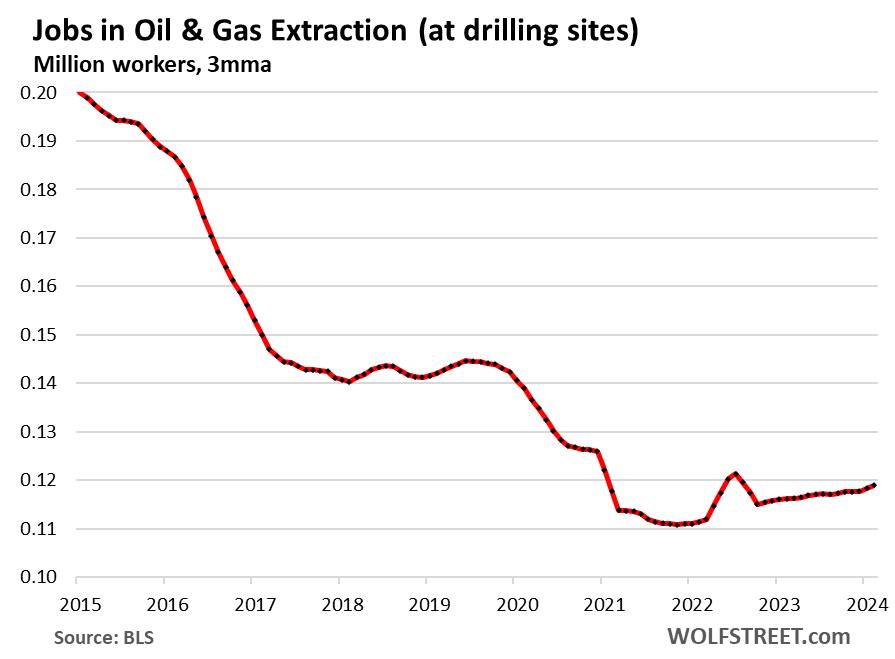
Oil and gas extraction, tracking employment on drilling sites. This tiny sector in terms of employment is huge in global significance.
US production of crude oil and natural gas has exploded since fracking became a big factor in 2008. By now, the US has become the largest producer of crude oil and natural gas globally, with crude oil production in 2023 soaring to a record of 12.9 million barrels per day, as the US became a net-exporter of crude oil and petroleum products; and with natural gas production soaring to a record 41.3 trillion cubic feet in 2023, as the US became the largest LNG exporter in the world.
The oil and gas sector has armies of workers engaged in technical, scientific, management, and support work in office towers and labs, and those employees are accounted for in the vast sector of Professional and business services and other sectors. And it has workers engaged in the Transportation sectors, etc., that are accounted for in their respective sectors.
But only a small number of people work around drilling rigs. And even as production has soared, employment plunged during the years of the Great American Oil Bust starting in 2015, when over production cause the price of oil in the US to collapse, and hundreds of drillers filed for bankruptcy. The solution was technical innovation, cost cutting, and labor efficiencies to bring down production costs.
Employment around drilling rigs bottomed out in late 2021 and has since then picked up some but remains very low despite record production.
- Total employment: 119,000
- 3-month growth: +2,000
Professional and business services, the largest sector by employment, includes Professional, Scientific, and Technical Services; Management of Companies and Enterprises; Administrative and Support, and Waste Management and Remediation Services.
Some of the tech and social media companies are included here, others are in “Information” (below) or in other categories.
- Total employment: 22.9 million, a new…
Read More: Employment Trends in Manufacturing; Construction; Oil & Gas; Professional &